I attended the Illinois Bike & Walk Summit hosted in Springfield by Ride Illinois, and I suppose not surprisingly, I found scores of like-minded people: bicyclist and pedestrian advocates working on things like connecting trails, creating actually good bike-ped infrastructure, and worrying about auto traffic’s impact on lives.
Here are my key takeaways from the summit.
‘Paths to the paths’
I attended a few sessions that involved work on existing or proposed bike trails, or establishing bike routes within towns, and one recurring theme was the need for “paths to the paths” — connections among them, or even just convenient ones to them. Engineer Mike Kerr, president of CBBEL, said in one session that while creating paths in communities is hard enough, residents often complain, or simply resist paths, because there’s not a good way to get to them by bike or foot. So creating access points is as much of the challenge as the paths themselves.
It’s the economy, stupid
Why should bike paths or routes be built? As advocates may struggle to persuade local authorities to support building paths, one argument repeatedly came up: They’re good for the local economy. If you build a good trail, people will come to it — then after they get hungry and thirsty, they’ll go to the eateries and bars in town. Or otherwise they’ll view the town favorably and keep coming.
It’s the community, stupid
But even where there’s not a business district within a community, planners said they’ve encountered situations where it was a groundswell of residents who simply wanted bike paths or routes to make their town better and encourage gatherings.
Des Plaines River Trail
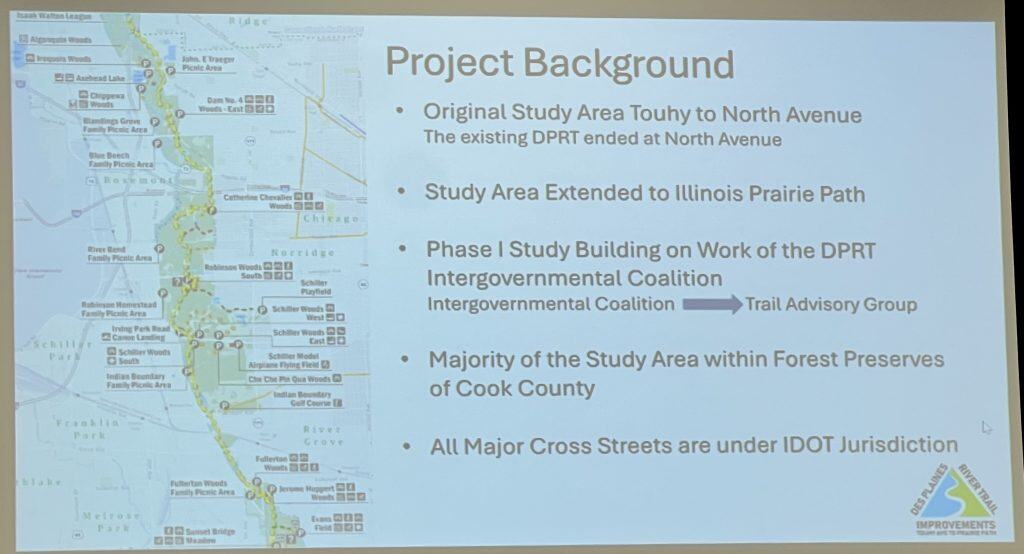
Speaking of a large-scale community effort, Franklin Park Mayor Barrett Pedersen was credited with organizing the myriad municipalities and agencies involved in the improvements to the Cook County portion of the Des Plaines River Trail. And could the work actually be done this year, ending the really rough riding especially south on the trail and terrible crossings like at Irving Park Road? I have to look at the plans even more.
East Illinois Prairie Path work
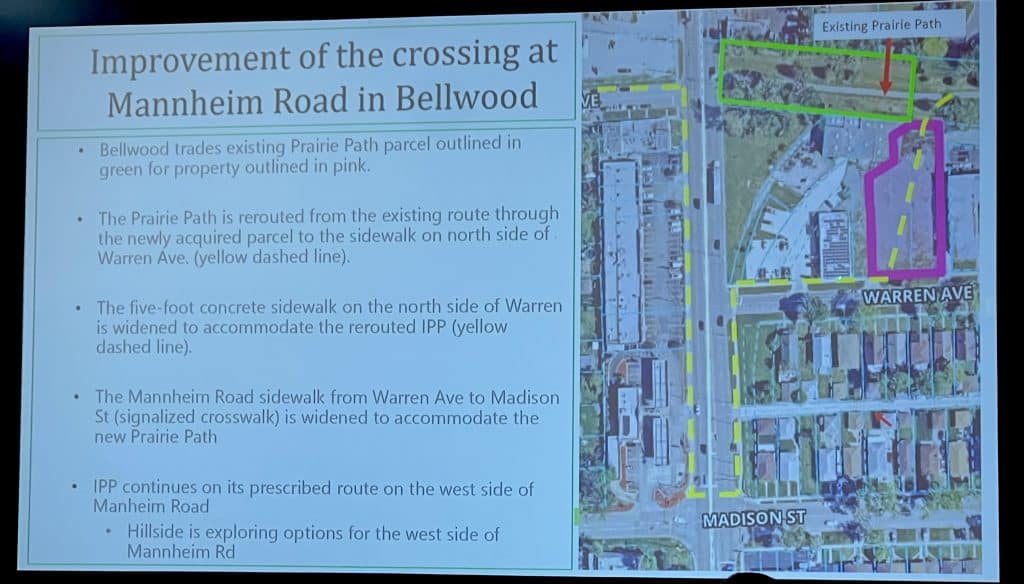
Meanwhile, the eastern (Cook County) end of the Illinois Prairie Path got some attention at the summit. First, Prairie Path board member Ralph DiFebo talked about the ideas to improve the path’s dreaded crossing of Mannheim Road in Bellwood. DiFebo said the organization worked out a land trade with a business property owner to facilitate a path detour. Then there’s the talk of extending the path from the Maywood trailhead to the CTA terminal in Forest Park. A good connection between the Des Plaines River Trail and the Prairie Path also came up at the summit.
Sidepaths vs. bike lanes
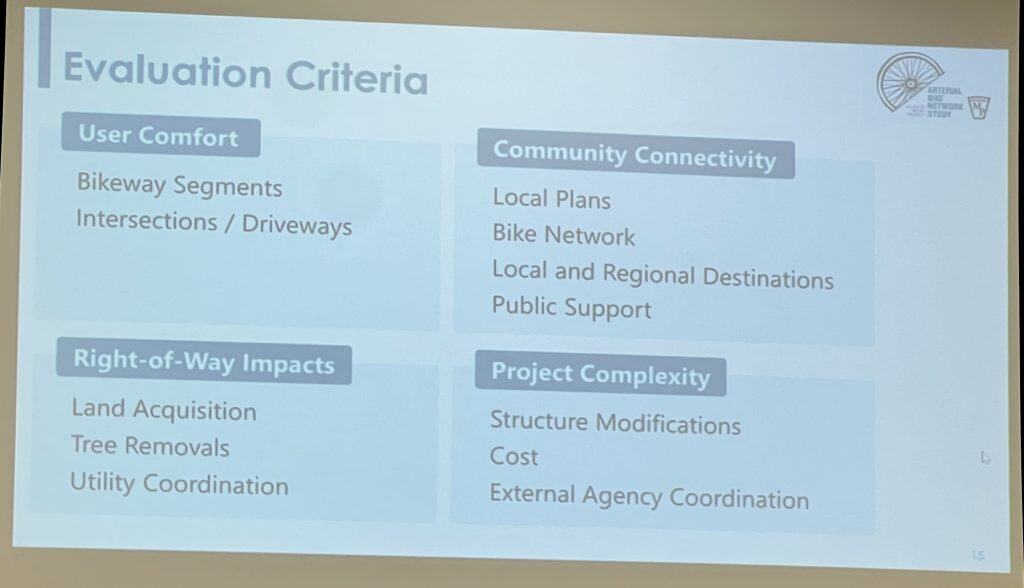
As Schaumburg and other suburbs work with both off-road paths and bike lanes, Mike Kerr, fellow engineer Steve Pautsch, planner Eric Mueller, and Luke Foresman, project engineer for the Village of Mount Prospect, discussed the virtues of off-road paths vs. bike lanes vs. unmarked bike routes within towns. It all depends on a number of factors: space, landscape, traffic, surrounding development, residents’ wishes, funding, politics. And maybe the ideal solution can’t be achieved, but something can, so that’s what has to be done. Their session speaks to the difficulty and all the work in creating infrastructure.
So many agencies
Part of the difficulty in creating local bike routes and bike-ped infrastructure is that there are so many agencies involved. Paths, even within towns, could cross jurisdictions — what if a main road is also a state route? Is there land that falls under a park district’s or county forest preserve district’s jurisdiction? What if one town wants a regional trail but the neighboring one doesn’t? So much to negotiate.
So much competition for funds
And of course, everyone’s competing for the government funds — which vacillate with budgets and politics. Not only are bike-pedestrian advocates competing for the available dollars, but so many others are, too, like road planners and overall infrastructure project organizers, to say nothing of advocates for schools, the sick, the poor …
Secretary LaHood’s message
Finally, is Ray LaHood my new hero? I should have known how much the former congressman and Secretary of Transportation under President Obama was an advocate for trails, specifically the rails-to-trails effort and overall non-motorized transportation. He’s now involved in efforts to fill a 16-mile gap between the I&M Canal Trail and the Hennepin Canal, which would also help complete the Great American Rail-Trail. During the summit’s lunch gathering, he maintained a calm and reassuring tone as he acknowledged the current headwinds in alternative transportation funding. He implored us to be patient and keep going, to not stop trying to get projects big and small done, because support ultimately will come one way or another. All the work has taken time and will take time.
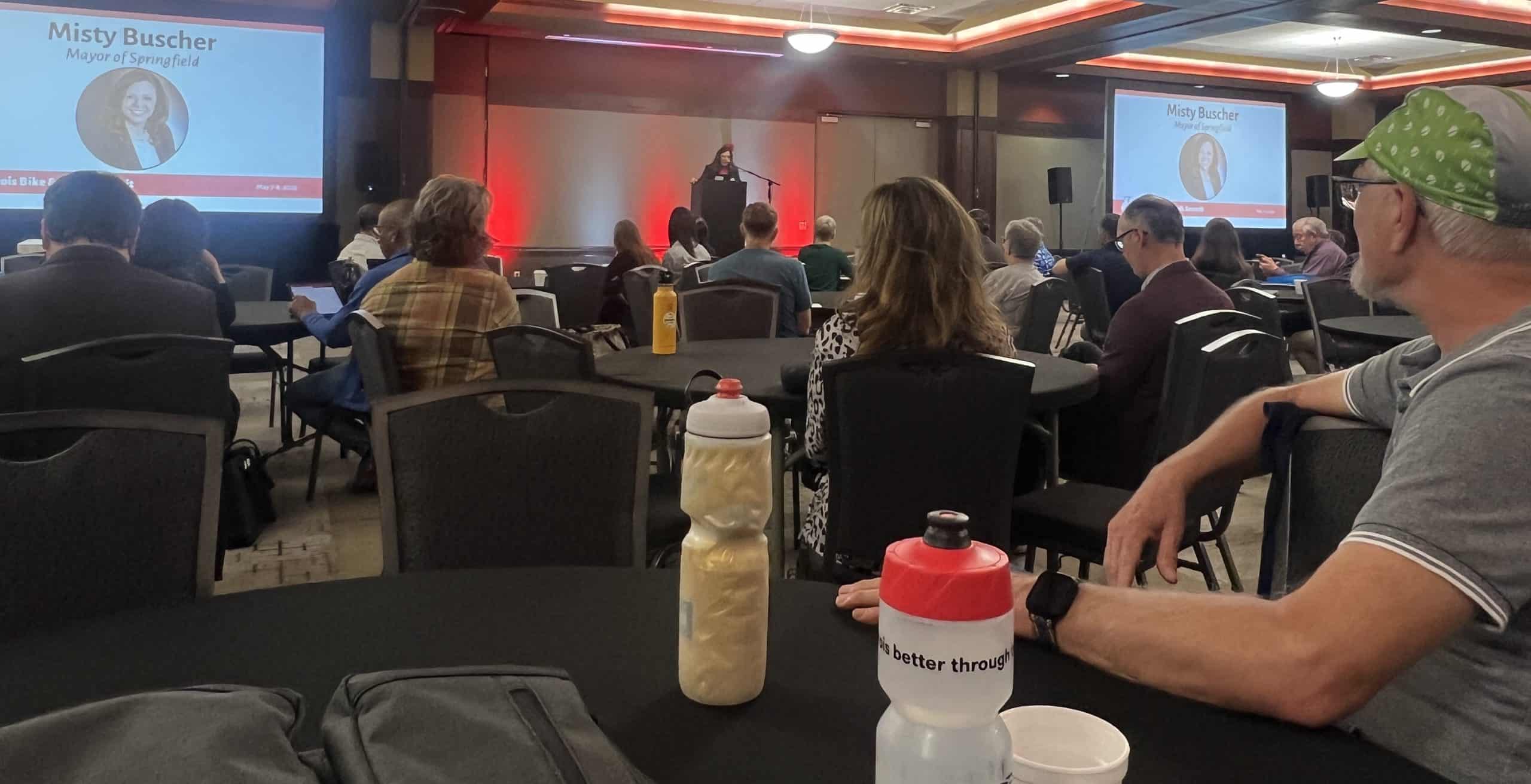
- At top, Springfield Mayor Misty Buscher welcomed those attending the Bike & Walk Summit and touted bike path plans in her city.
Like this? Please consider a donation