A Cook County forest preserve planner said last fall that the district was “currently focusing on an evaluation of the Thorn Creek Trail system” ahead of one for the Busse Woods trail.

The district did some patching of the Busse Woods trail in 2025. It had become full of cracks and still now has some potholes. The planner said last summer a full repaving evaluation “is anticipated in the next year.”
But no Busse Woods trail work is listed in the forest district’s latest five-year capital improvement plan.
The Thorn Creek Trail did make the capital plan — as a spot where work was completed over a couple of years.
“Final work, under a $3 million contract awarded in 2023, was completed on severely eroded portions” of the Thorn Creek system in 2025, the capital improvement plan says.
I went to take a look at the Thorn Creek Trail to see what kind of shape it’s in now.
Thorn Creek basics

The Busse Woods and Thorn Creek trails are on opposite sides of Cook County.
Busse Woods is well northwest, between the borders of Schaumburg, Arlington Heights and Elk Grove Village. Thorn Creek is well southeast, running through Park Forest, Chicago Heights and Glenwood, nearly to the Indiana border.
The Thorn Creek system is 18.5 miles of paved and 3 miles of unpaved trails. Part of the system is a 3.5-mile loop around the Sauk Trail Woods.
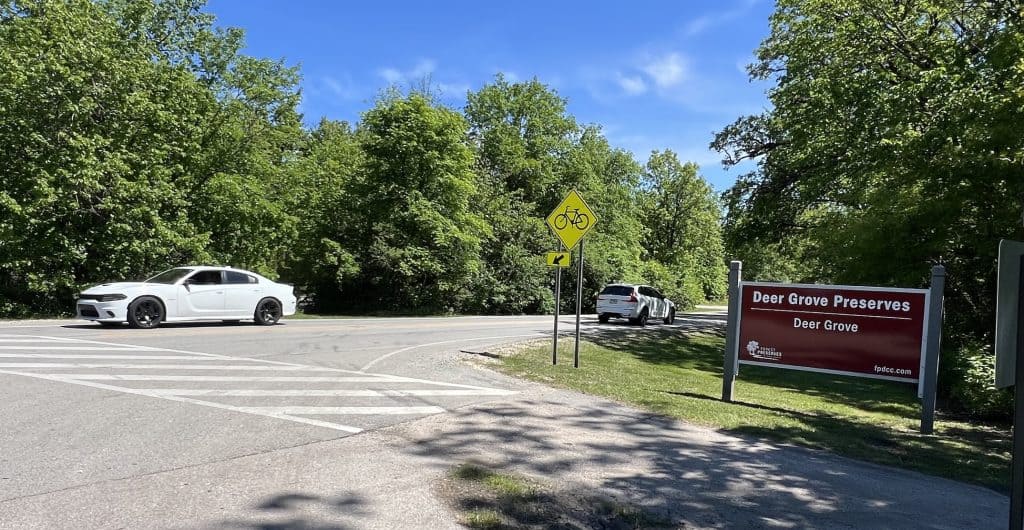
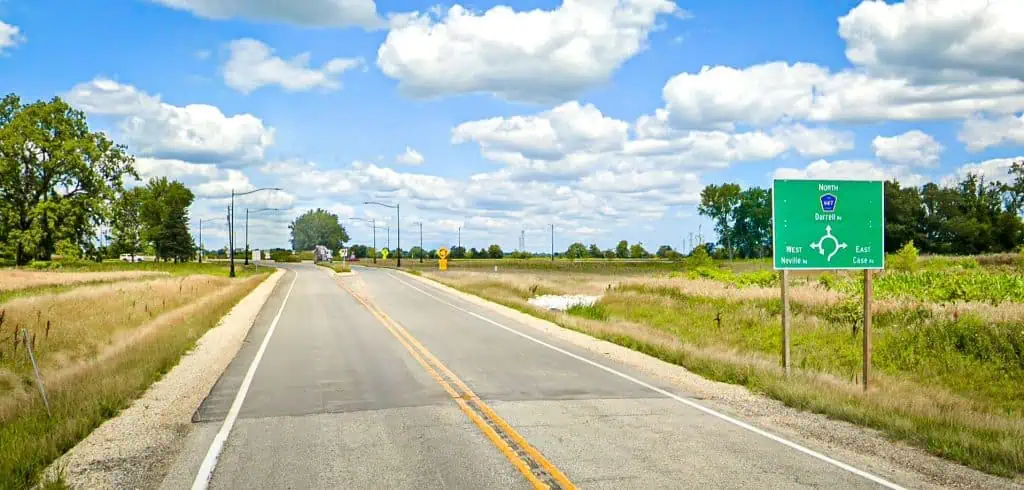
Just north of that loop, Thorn Creek connects to the eastern end of the Old Plank Road Trail in Chicago Heights; that connection was made not too many years ago. Just south of the loop is the last 1.5 miles of Thorn Creek (picture at very top of this article) to Steger Road and Western Avenue.
The bulk of the Thorn Creek Trail runs north from that Old Plank Road terminus through Chicago Heights and into Glenwood, then largely east through quiet forests until it ends in Lansing. If you want to ride on the major unpaved trail, you could make a loop on the northeast end — sort of, as I’ll explain later.
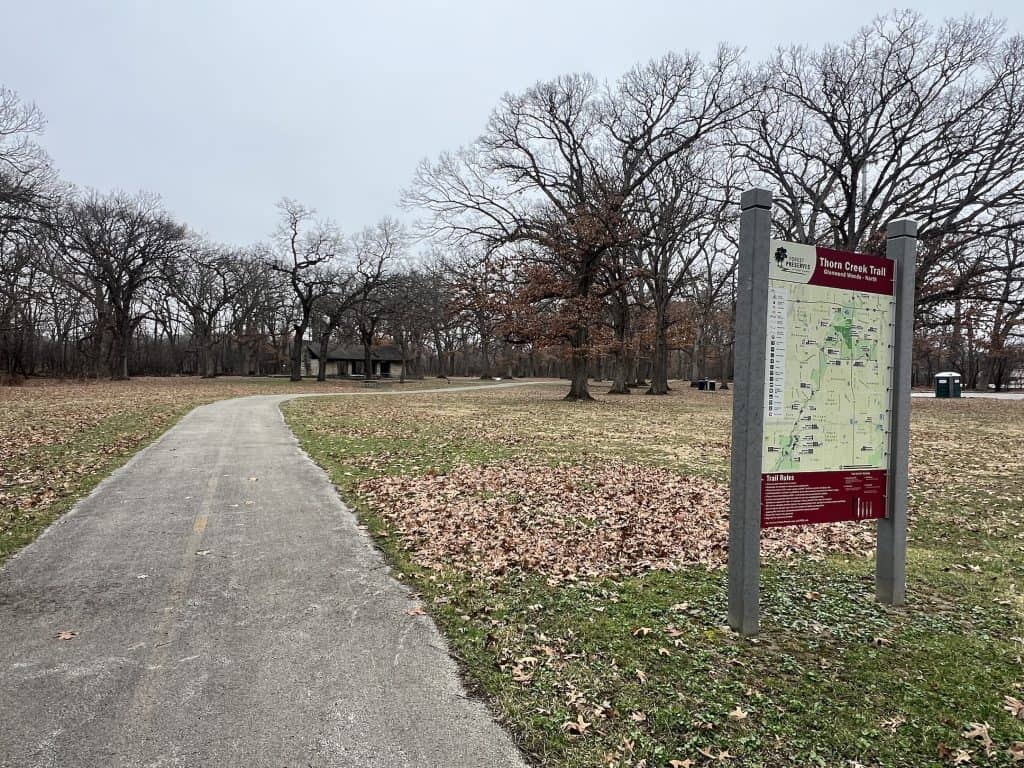
All in all, you could ride about 15 miles one way over the system and easily make more than a 30-mile round trip if you ride out and back plus do the loops. Add an out-and-back Old Plank Road Trail option for as many miles as you wish.
Plus, you could ride north through Lansing neighborhoods for a couple of miles and pick up the Burnham Greenway Trail or the Pennsy Greenway.
The Thorn Creek Trail crosses some lightly trafficked streets and has bridges and underpasses. It’s good for casual bicyclists and serious cyclists, and its proximity to neighborhoods makes it good for families, too.
What Thorn Creek’s like
As I’m based in Cook County’s northwest corner, this was a reconnaissance trip for me. I parked in Park Forest and rode a couple of miles of the Old Plank Road Trail east to pick up the Thorn Creek Trail.
There the trail is definitely not a full 10 feet wide and is unstriped, but it’s in decent condition. I headed northeast where the curvy trail runs through the nice enough Indian Hill Woods and soon right along the actual Thorn Creek. It weaves through neighborhoods as well as Halsted Woods and Joe Orr Woods.
Soon it heads straight north on the west edge of Glenwood Woods South, until it briefly runs along Chicago Heights Glenwood Road and crosses over to Glenwood Woods North.

The forest district’s Thorn Creek Trail page has a year-old alert warning of “intermittent construction activities” north of Glenwood Woods. I found that the trail was dark gravel along Chicago Heights Glenwood Road; I’m guessing that’s temporary but don’t really know.
Otherwise the trail is largely in good condition and returns to a typical width. It may or may not be striped — the stripe is faded in a lot of places — but I didn’t see too many cracks or bumps.
Plus it’s a lovely ride through Glenwood Woods.

I compare the trail’s condition to the eastern Will County half of the Old Plank Road Trail, which was repaved in 2022 — but it’s not as good as the wonderful west Will County half of Old Plank that was just repaved last year.
Also, when I rode the paved trail in a damp week in early March, I did not find any flooding at the Route 30 underpass, but there was a little bit of slippery dirt in it. Maybe the erosion work the forest district speaks of was more on the unpaved trails.
Forests and a great bridge

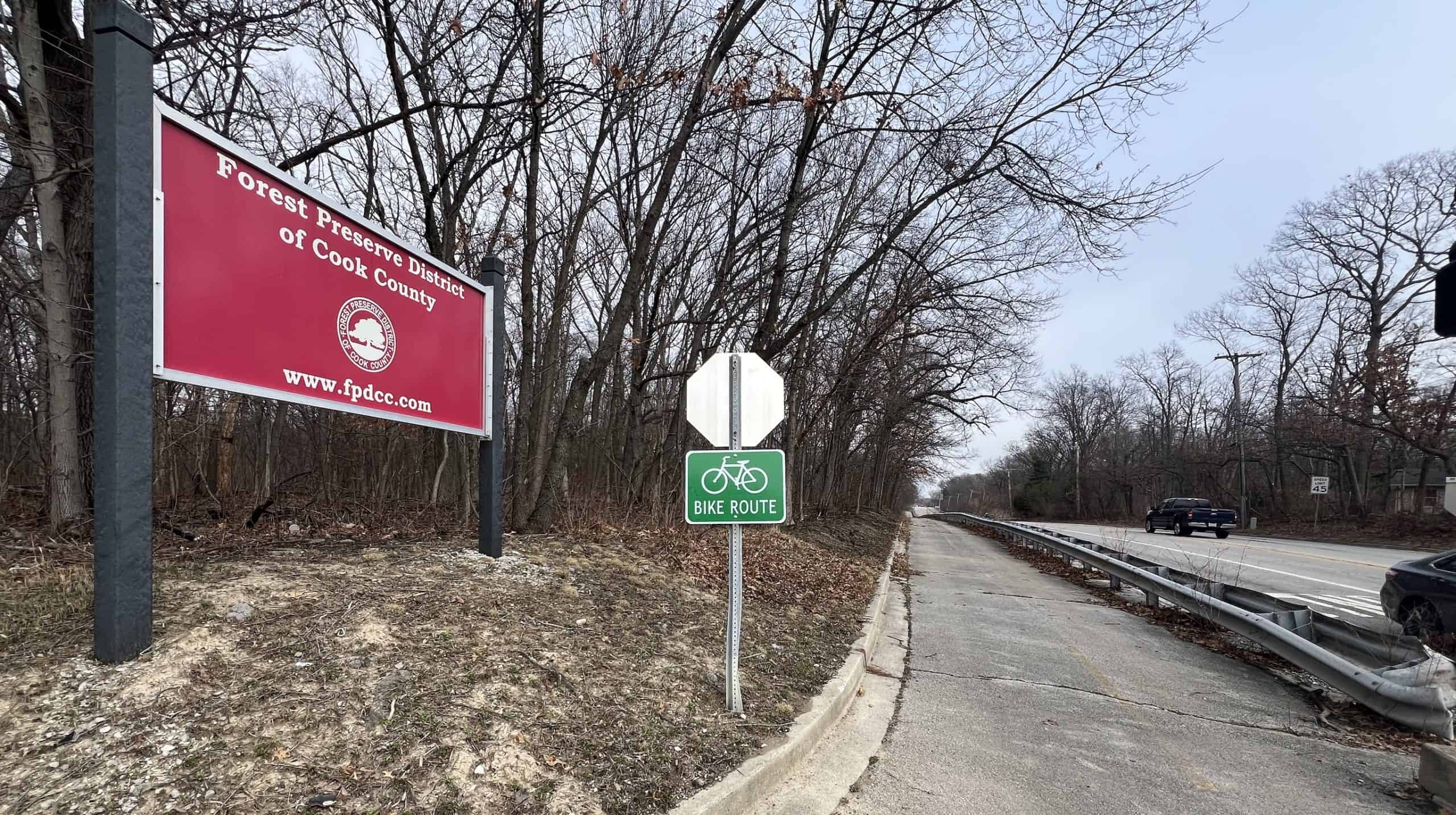
The Thorn Creek system in 2025 was added to the forest district’s program to improve trail safety mostly by removing bollards, or drop gates. They were removed at Busse Woods, too, in 2025, and some of their concrete bases were paved over — but some were not.
The bases all remain in the Thorn Creek system. Some even show gravel where the bollards were. Maybe the forest district will be paving over the remaining bases at both Busse and Thorn Creek this year.
From Glenwood Woods, quickly you encounter a cool bridge over railroad tracks. It’s long and lined with fencing — which even covers the bridge at the top.

The trail continues east, with some north and south zigzags, through a few pretty forest preserves: Sweet Woods, Jurgensen Woods and Brownell Woods. It’s rather peaceful riding. Then after crossing Route 83, the trail shoots north one final time to Lansing Woods, where it ends at the 186th Street entrance.
You don’t have to be finished; you can go on the “yellow” unpaved trail, though it may not be easy. I didn’t try it, but the maps suggest you actually have to leave Lansing Woods and get to Oak Avenue to the west, then head south to 188th Street. You’d ride to busy Torrence Avenue, look slightly to the right and see the gravel beginning amid the trees across the street.
You could also access this trail through the Jurgensen Woods preserve off 183rd Street east of Thorn Creek Road/Cottage Grove Avenue. That requires exiting the paved trail and the woods, too, and riding those roads about a quarter-mile. And you have to make sure the Jurgensen Woods preserve is actually open, as it was to be “closed for land management” through March 31, the forest district said.
Side trip to Lansing and the Burnham Greenway


Another way to keep going is to leave Lansing Woods and ride 186th Street east into Lansing. The road isn’t too busy. Head to Chicago Avenue and turn left to ride through the neighborhoods.

For a mile and a half, the forest district actually counts this as part of the “green paved” trail (“non-FPCC”) in the Thorn Creek system.
Then you intersect with an actual trail again. For a little bit it continues northwest as the Thorn Creek Trail.
Or you could turn right, or southeast, at which point the trail is the Pennsy Greenway leading into Indiana. The border’s hardly a mile down.
But if you continue north under the I-80/94 expressway, the trail becomes the Burnham Greenway Trail, going through Calumet City.
It’s not a bad ride at all through trees even if alongside businesses, and soon you go through the small Melos Woods, nice with more tall trees.
The trail ends at State Street; other portions of the Burnham Greenway system pick up later in Chicago.
Back on the south end
Way back south of the Thorn Creek Trail’s connection with the Old Plank Road Trail, the 3.5-mile “black” paved loop through the Sauk Trail Woods is about a mile down.


The trail then runs along Sauk Trail Lake for a little bit. That provides some nice views, but the scenery gets even nicer when you enter the real woods.
The Sauk Trail Woods are small enough to feel independent, too. The trail is in good condition here, seeming fairly new, as it weaves through the big trees, yet on the east side you still feel South Chicago Heights streets and homes nearby.
Finally, after crossing Sauk Trail the road, you’re on the homestretch of the Thorn Creek Trail. You ride through more tall trees until the trail concludes alongside Steger Road.
It ends unceremoniously at a busy intersection with Western Avenue. This southern stretch is where the trail is in its roughest condition.
But overall, the Thorn Creek system is in good shape. The forest district can move on to bumpier problems such as the Busse Woods Trail.
• Do you find little tours and information like this valuable? This free website is made possible almost entirely by readers like you. Consider donating to help defray the costs of gathering and presenting this material.