It’s time for the “dog-day” summer cicadas to sing, if you haven’t noticed. That had me thinking of my adventure last year to bike in search of those 17-year cicadas. Remember them?
The emergence of the 17-year cicadas in the Chicago area was an event in 2024, but not every resident got to experience them. That’s because they weren’t everywhere in the Chicago area. In fact, they were not around my home in Schaumburg at all. My wife was relieved.
So last May and June, my bicycling mission was to seek out the shrill of the 17-year cicadas.
It wasn’t too hard. I just had to ride south into DuPage County, or even just a little bit east to Busse Woods in Cook County. (I understand there were many along the Des Plaines River in Cook County; I happened not to venture that far east.)
Where I rode to find them
From Schaumburg on May 31, I proceeded south through Roselle and Glendale Heights, and I finally started to hear them in Carol Stream neighborhoods. In woodsy areas a little more west like Winfield, I could hear them, too. But I never heard any as far west as St. Charles or the Fox River.
Where I really hit paydirt (be careful where you step) was DuPage County’s hallmark trails, the Illinois Prairie Path and Great Western Trail. DuPage forest preserves like Churchill Woods were big hosts, too.
It was a joy enough to start to hear them a week earlier in Busse Woods. The shrill wasn’t constant there; I heard the cicadas’ buzz only in spots on the south side closer to Arlington Heights, including a little over the eastern Higgins Road bridge.
But once I entered the forested areas of the DuPage trails or preserves, the singing was unmistakable. And it was reinforced by sightings: The cicadas were flying around, too, though I’m happy to say I wasn’t getting pelted by them; only one or two hit me.
That shrill sound
I learned from Kaci Athey of the University of Illinois Extension, speaking to the Daily Herald, that there were really three cicada sounds we were hearing in 2024. That’s because the 17-year cicadas in northern Illinois, periodic cicada Brood XIII, really are three species, Athey said, and they have different songs.
“There’s one that sounds like a buzzing; it’s probably the loudest one,” she told the Herald. “There’s one that has been likened to a whirring spaceship noise, the second-loudest one. And there’s a third one that kind of sounds like a knocking.”
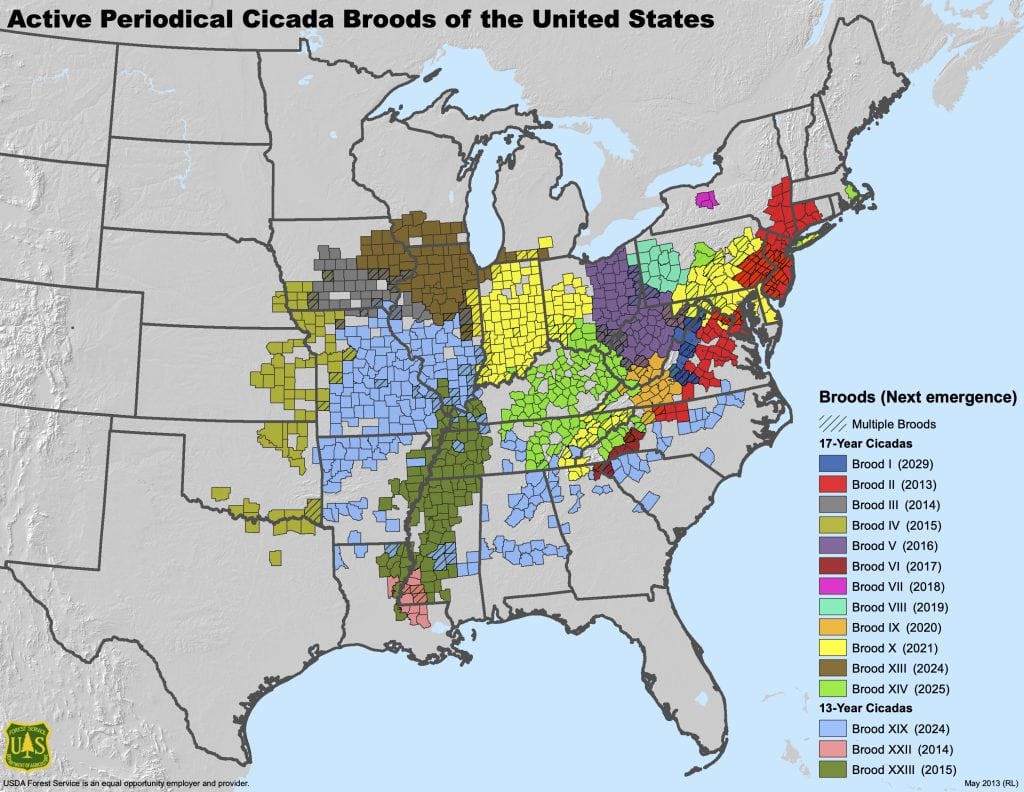
You may recall that there also was a 13-year cicada brood singing in the country last year, and it reached into Illinois, mostly south. That’s not Brood XIII but Brood XIX; I guess they just missed synching with the scientists’ numbering system.
Anyway, the periodic cicadas all settle underground for all those years to feed on tree and plant roots, then emerge in their time. Scientists don’t really know why they take so long, though the University of Illinois Extension presents theories.
Their particular buzzing was easy to recognize, as it was unusual to hear it as early as May and even June. But that spaceship shrill really was the hallmark of the periodic cicadas last year. What a wild, enveloping sound. Remember? Listen on my video.
Back to our annual cicadas
The periodic cicadas have an awesome species name: Magicicada, according to the Chicago Botanic Garden. It cites Penn State University in saying they are found nowhere but the Midwest and Eastern U.S.
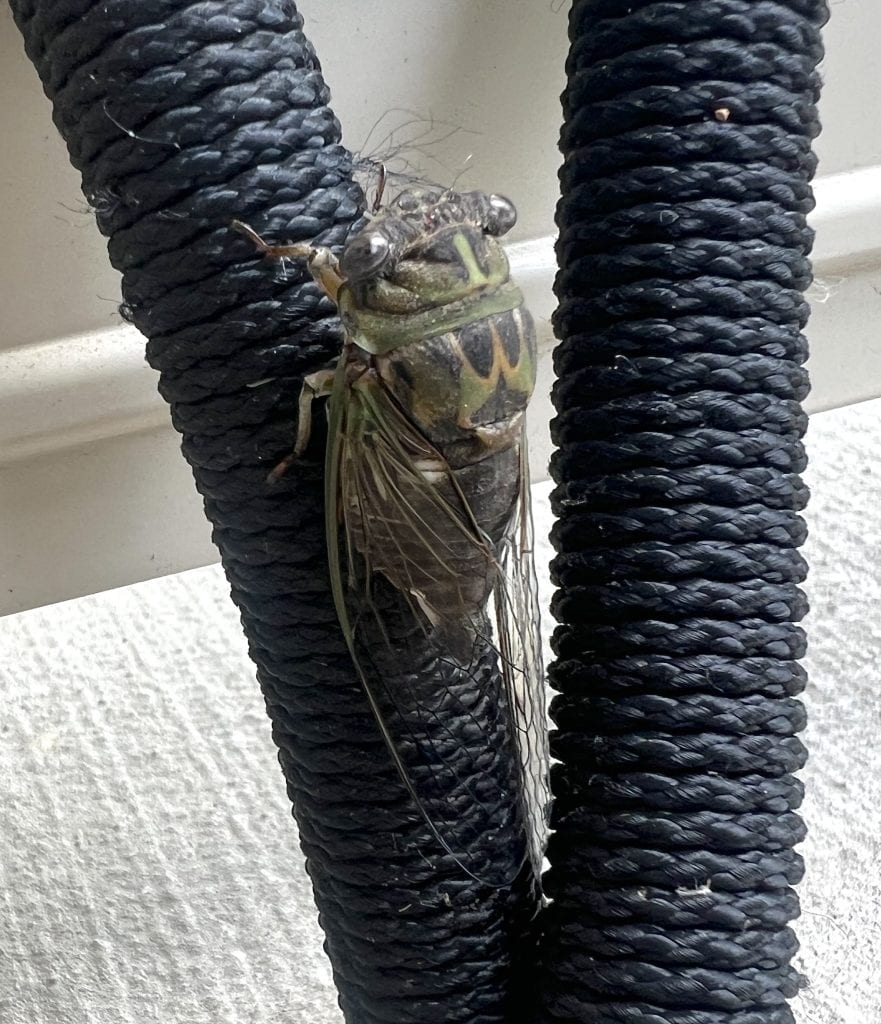
Then there are our annual or “dog-day” cicadas, kind of the less organized cousins. Scientifically called Neotibicen canicularis, they appear usually July through September in Illinois, the U of I Extension says. It typically takes them two to five years to complete their development, but they are not synchronized, so plenty emerge every year.
There are many species of dog-day cicadas, the Extension says. They are also called harvest flies, because various crops are being harvested at the time of their emergence. But all their colors are less dynamic than those of the 17-year cicadas, which have those bright red eyes.
Only the males of any cicada species sing; it’s a mating call to females. The noise comes from vibrating their tymbals, which are two rigid, drum-like membranes on the undersides of their abdomens, the Botanic Garden says. Females don’t have them.
Why the periodics weren’t everywhere
Despite the USDA Forest Service map that shows large portions of the country where the periodic cicadas hang out, why didn’t they emerge in every part of every suburb last year?
Well, the experts say, not every piece of ground is suitable for the cicadas. Think of land covered by turf, of course. Or the sun doesn’t shine on all spots to soften them up adequately for the cicadas.
But also, once they do emerge, the cicadas don’t get around much.
A periodical cicada flies less than half a mile from its resting place, the Illinois Extension says. So even over generations — the Extension points out that we’ve had only nine cycles of the 17-year cicadas since Abraham Lincoln’s law days — it expands its territory very slowly. Like, only about 5 miles since Lincoln’s time.
Then I might have messed with nature when I took a 17-year cicada for a ride in DuPage County last year. He landed on my thigh and cruised with me, even with my leg rotating up and down. He finally flew off 7 miles later.
I named him Occhi, pronounced “okie” like okie-dokie. “Occhi” is Italian for “eyes.” It was good hanging with you, Occhi. Maybe I’ll see your brethren, in a different family (sorry about that), in 2041?
• Did you enjoy this information? Please consider a donation to keep material on this website coming, and thank you for reading.