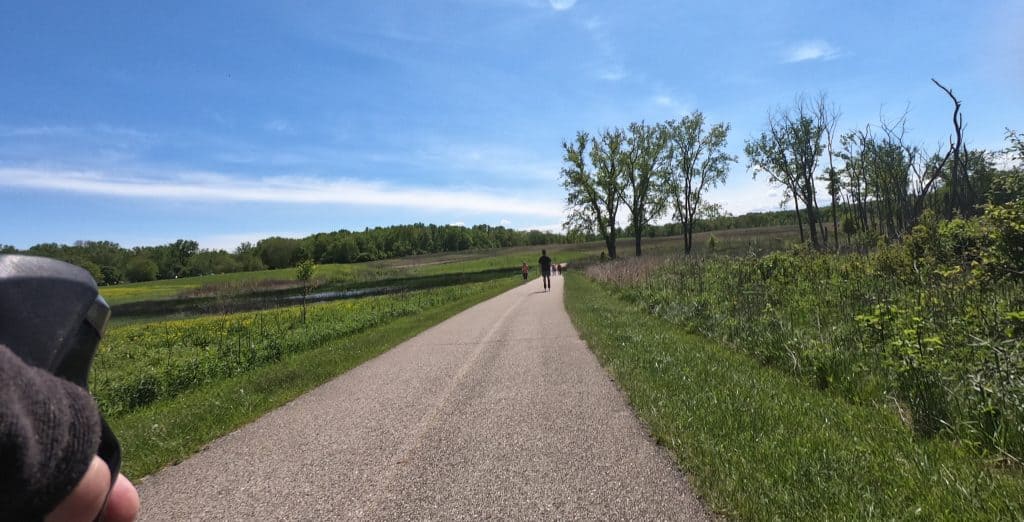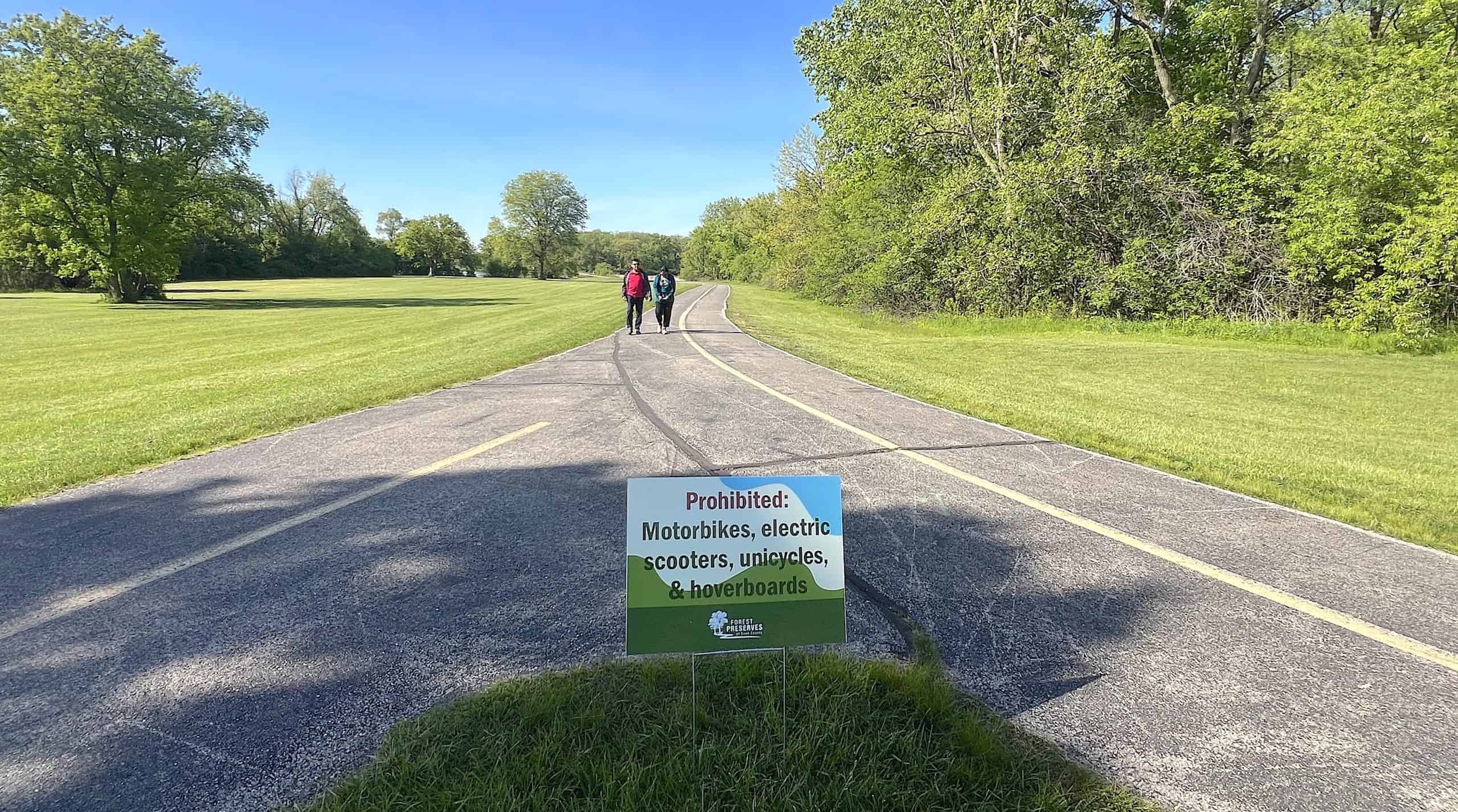
Seen in northwest Cook County’s Busse Woods this spring: Signs that reiterate what’s not allowed on the trails.
“Prohibited: Motorbikes, electric scooters, unicycles & hoverboards,” the signs read.
The new signs, simply stuck in the ground or attached to existing sign posts, come amid the flurry of local e-bike laws enacted in 2025 and as the Illinois legislature in 2026 is working on new laws to regulate what have been called e-motos as well as e-bikes and other “micromobility devices.”
That state legislation comes after advocacy group Ride Illinois’ and Secretary of State Alexi Giannoulias’ campaign to update state law to officially distinguish e-motos from e-bikes. Only e-bikes are in the state vehicle code now.
The Cook County forest preserve district has long had its own rules on e-bikes, as have other counties’ forest districts.

Only Class 1 e-bikes, which have motors that can help riders travel up to 20 mph if they pedal, and Class 2 e-bikes, which can go up to 20 mph with just a throttle, have been allowed on Cook trails. Class 3 e-bikes, which can hit 28 mph, have not been allowed.
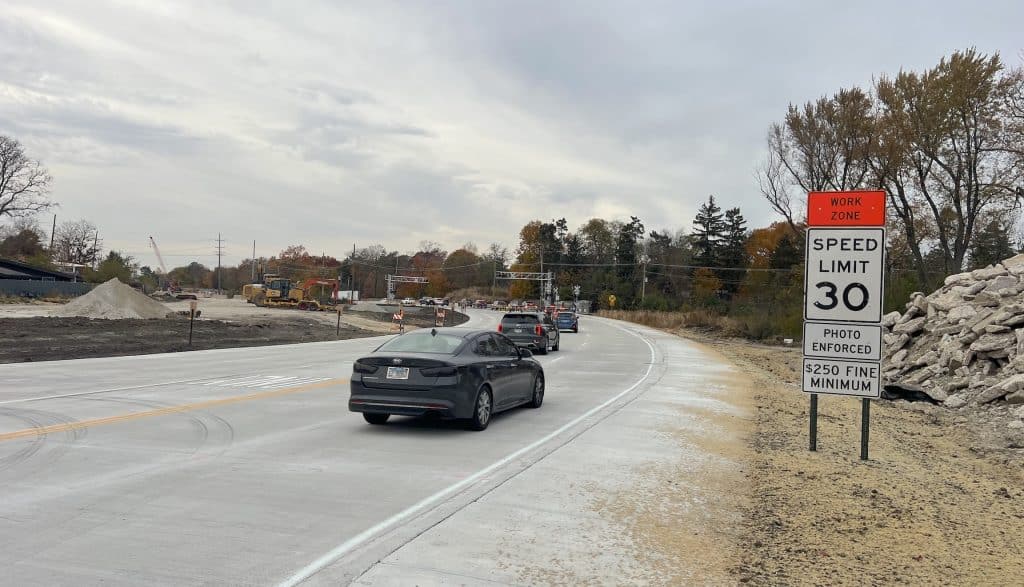
No matter what, and whether a bike is electric or not, Cook County trails have a 15 mph speed limit. And no e-bikes are allowed on single-track mountain bike trails.
E-motos refer broadly to any bike with motor power of 750 watts or more. The new Cook forest signs use the equally broad “motorbikes” term.
The forest preserve district’s “Bicycling” web page gets somewhat more specific. Among “recreational devices NOT allowed anywhere,” it says, are the Class 3 e-bikes as well as gas-powered vehicles — “ATVs, motorcycles, etc.”
Also not allowed are “electrically powered recreational devices” — e-scooters, motorized unicycles, hoverboards “or similar devices.”
“People with mobility limitations are allowed to use personal mobility devices,” the district page says.
The signs also come as the forest preserve district is touting its police patrols. “E-bikes [speeds] are definitely an issue that people have, because some of them can go over 15 miles an hour,” Officer Maria Devogelear says in a May 8 forest district article. “Anything that can go above the speed limit is a risk for the public, so it’s very important that people are using this equipment safely.”
Proposed state law
The Illinois Senate on April 15 passed legislation that would treat e-motos like motorcycles or cars — meaning a driver’s license and registration would be required — and dictate that riders of legal e-bikes be at least 15 years old.
It would override and prevent individual suburbs’ laws, many of which have set a minimum age for e-bike riders or require a driver’s license. Some towns have banned e-bikes in public outright.
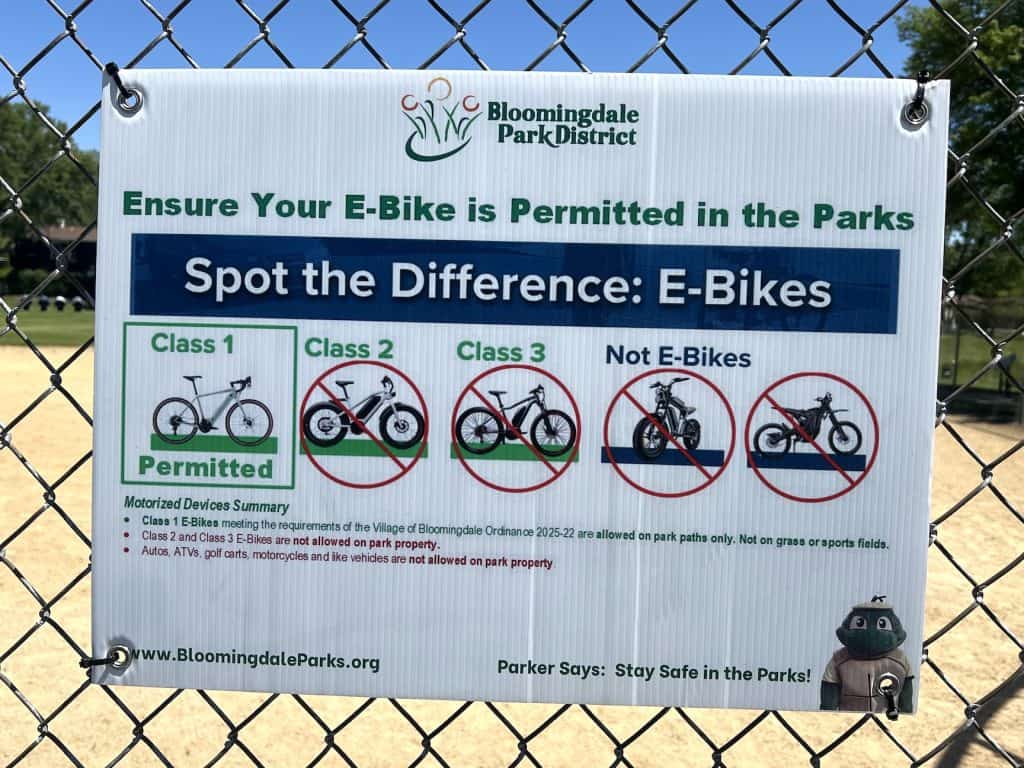
But as of mid-May, the legislation would still let local park districts, park districts and conservation districts set their own rules for e-bikes on paths. Many now do, maybe even more strict than the town at large. They might allow only one class of e-bike or not allow the motor to be used on park paths.
The legislation would take effect in 2027, but these districts’ rules could stand. Many park districts have posted signs about their regulations.
The legislation would call electric skateboards, electric unicycles and all electric scooters “electric micromobility devices,” which would be considered “motor vehicles.” They therefore would not be allowed on trails, and their riders would have to be at least 16 years old.
Other forest districts
Other counties’ forest preserve districts have had regulations and guidelines on e-bikes, even if they sometimes contradict themselves.
The Lake County Division of Transportation says this: “Ebikes can be utilized on Lake County-maintained bike paths. While motorized vehicles are not permitted on our bike paths, the State of Illinois has determined that class I, II, and III ebikes are not motorized vehicles and can be used on paths.”
A forest preserve district web page with guidelines says the same thing. Detailed forest preserve district regulations from 2020 suggest a 20 mph speed limit, as does the guidelines page, but the regulations also basically say you can exceed that limit if you do it safely. The official regulations also contradict the other guidelines by saying only Class 1 e-bikes are allowed on forest trails.
The DuPage County Forest Preserve District’s Rules and Regulations page counts as legal bicycles e-bikes whose maximum speed “on a paved level surface … is less than 20 mph.” We presume that means Class 1 and 2 e-bikes, even though their top speed actually can hit 20 mph.
But a DuPage County web page says “all classes of electric bicycles are currently allowed but should keep to the recommended safe travel speed of 15 mph or less.” The forest preserve regulations don’t list a speed limit.
The Kane County forest district’s regulations mirror DuPage County forest district’s almost verbatim, therefore presuming only Class 1 and 2 e-bikes are allowed on trails. But they do add a 15 mph speed limit for all bicycles.
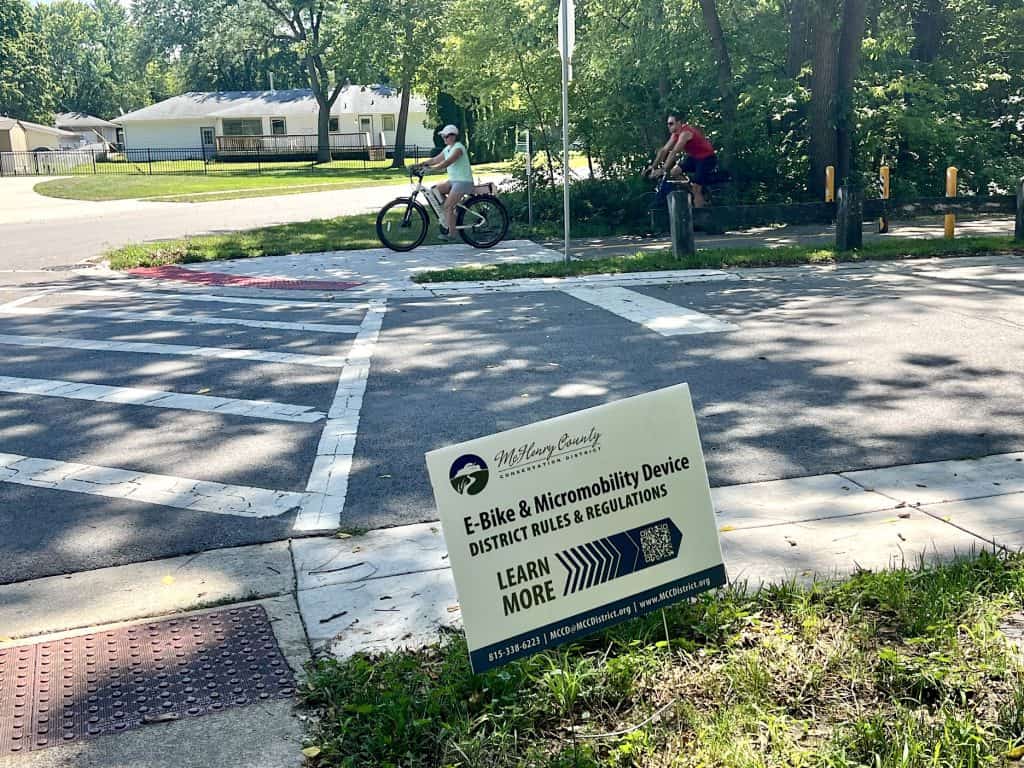
In McHenry County, the Conservation District updated its ordinance in 2025 to say any e-bike is allowed on trails, as well as e-scooters, all with a speed limit of 15 mph. “Specialty micromobility devices” that include e-unicycles, e-skateboards and hoverboards are allowed with a 10 mph speed limit.
The Will County forest district e-bike rules used to be the same as DuPage’s and Kane’s, but now its “biking regulations” page says only Class 1 e-bikes are allowed.
• Do you find up-to-date information valuable? It’s provided for free with the help of readers like you. Consider donating to help defray the costs of this website and gathering the material for it.