Every fall when daylight saving time ends, or even before once the autumn equinox hits, we bicyclists know it’s getting dark too early — and it’s time to ride with the lights on. That’s not a bad idea during the end of winter, either, when sunsets are still early.
But when daylight saving time begins, should we keep the lights on?
Some pro cyclists have gotten behind a daytime running lights campaign, motivated by the deaths of peers killed on the road during training rides. The “Be Bright Wear A Light” campaign was started in 2023 by Australian Rachel Neylan; she first had the idea in 2018, when, she said, she was starting to notice more pros riding with lights on during the day, because roads were getting busier. The pandemic interrupted, then the death in November 2022 of Italian Davide Rebellin and another in February 2023 of Spanish neo-pro Estela Domínguez motivated Neylan to begin the campaign in earnest.
The campaign that year got the quick endorsement of Tour de France champion Tadej Pogačar. “This is the best safety measure I can take,” he posted on social media. “For the amount of time I spend on the road and minimal investment it takes to use a light it’s a logical part of my daily training now.”
“When you start using lights, you see that cars give you so much more passing space and you avoid near misses.”
Rachel Neylan, to Cycling Weekly in 2023
Neylan wanted to spread the word on the practice to encourage all bicyclists, at all levels right down to families riding around home, to use lights during the day. “Pro cyclists aren’t going to brag about something they do in their everyday training environment, but it’s something I’ve noticed people doing in recent years, while younger kids and amateurs are not so much,” Neylan said.
But there’s not much activity lately on the campaign’s website. The X account for the campaign hasn’t had activity since April 2023, and I don’t see other social media accounts.
I know plenty of riders who use lights during the day, but I haven’t seen published advocacy for the practice in the Chicago area. There’s only been promotion of the importance of using lights at night. That’s actually required by state law and reinforced in many local laws. But those laws say nothing about using lights during the day.
There’s not even total agreement on the practice.
Research on daytime lights
An article in 2017 by Outside magazine’s Velo notes that daytime running lights were first used on autos in the late 1970s; they were more widely adopted a couple of decades later. Studies since have evaluated how well they reduce crashes. “Although exact figures vary depending on region and study specifics, most investigations have concluded that there is at least some benefit to vehicles using them on the road, generally hovering around 5-15% reductions in crash frequency,” the article says.
The one study on daytime bike lights most cited by various articles, and even posts by lawyers advocating for bicyclists, comes from Denmark. Permanent running lights were mounted to 1,845 bicyclists in Odense, Denmark, in 2004 and 2005, and the number of crashes was reported online by the bicyclists themselves. The same was done for 2,000 other bicyclists who had no lights mounted. The study, published in 2013, said the crash rate was 19% lower for the bicyclists with lights.

There’s also the science of how we process visual cues. The Velo article cites the work of psychologist Marc Green, who has a whole website about visual perception and how “to design a better and safer world.” We don’t consciously process everything we see, he says, because that would be too exhausting. “At every opportunity, people switch behavioral control from the conscious and resource-draining processing of attending the light entering the eyes, to an automatic and unconscious mental model.”
Or as the article put it: “Consider the last time you moved to a different address. How many times did you drive to your old house after work by mistake, seemingly on autopilot? And when you got there, did you even remember doing it? Could you recall what you saw along the way?” I myself kept driving to our old office location on dinner breaks after my company moved.
Also, as the article says: “People are also conditioned to look only for the things that they judge to be most applicable or important at the time — something commonly referred to as ‘selective attention.’ On the road, this means that drivers … are primarily looking out for other cars and trucks, not motorcyclists or cyclists.”
So then, a driver on their usual route might not “see” a bicyclist emerging on the road, even in daylight. In-vehicle distractions like screens don’t help. Lights on the bike might grab that driver’s attention, the thinking goes.
Certainly they’re viewed as critical at night, and our laws reflect that.
What our laws say about lights
The Illinois Bicycle Rules of the Road tell us to make sure our bicycles have the following safety equipment:
- Front light visible for at least 500 feet (night riders).
- Clear front reflector.
- Red rear reflector visible from 100 to 600 feet.
- Horn or bell that can be heard up to 100 feet.
- Reliable, properly adjusted brakes.
- Wheel-mounted side reflectors.
- Reflector pedals.
- Gears that are adjusted and operate smoothly.
- Properly adjusted seat.
- Handlebars and all accessories securely attached.
And the booklet says to “always wear an approved safety helmet.”
The booklet does note that “Illinois law requires a front light and a rear reflector when riding at night.” In fact, the Illinois Vehicle Code has a section, 11-1507, on “Lamps and other equipment on bicycles.” In a convoluted way, it says what the Rules of the Road says: That “every bicycle when in use at nighttime shall be equipped with a lamp on the front” that emits a white light visible from at least 500 feet, and with a red reflector on the rear visible from 100 to 600 feet. But the code also says “a lamp emitting a steady or flashing red light visible from a distance of 500 feet to the rear may be used in addition to or instead of the red reflector.”
The code also lists the reflector pedals and side reflectors as the Rules of the Road does; it actually sounds harsher about them, saying “no person shall sell” a bicycle not equipped with them. It says the pedal reflectors must be visible from 200 feet and the side reflectors from 500 feet. The side reflector provision can be met with “reflective materials which shall be at least 3/16 of an inch wide on each side of each tire or rim to indicate as clearly as possible the continuous circular shape and size of the tires or rims of such bicycle.” That explains how higher-end bicycles meet the requirements, though I’m not sure all our clipless pedals conform.

The vehicle code doesn’t say anything about helmets, by the way. But as the Chicago Bike Law Firm notes, “certain municipalities have their own laws that mandate helmet use for specific age groups. For instance, Skokie requires children under 17 to wear helmets when cycling.” (The Skokie code actually says under 16.)
Local laws seem to contradict state law on bike lights only in the slightest ways, if they even address them. Skokie does specify that a rear red reflector must emit reflected light visible from “approximately 200 to 250 feet away.” Schaumburg demands “at least one lighted lamp mounted on the rear” with a red light visible from at least 500 feet, or “a red reflector button” at least an inch and a half in diameter visible from at least 500 feet. Waukegan copies the state code verbatim. Evanston requires only a red reflector on the rear visible from 500 feet.
Libertyville has a “Bicycle Safety” page, but about lights and reflectors it says only to make sure they work. Elgin produced a flyer that says, “When biking at night, use a white headlight and rear red reflector on your bike.”
As far as advocacy goes, bicyclists are strongly encouraged by regional organizations to use lights at night. The Active Transportation Alliance made this video in 2015 demonstrating the need for lights at night and providing advice on them.
But nowhere in all the codes and advice is riding with lights during the day mentioned.
So what about daytime lights?
The concept of daytime running lights on bikes doesn’t come without controversy (as always?). First, some say that requiring or encouraging daytime light use puts the onus on the bicyclists — if they had been using a light, I wouldn’t have hit ’em — when the onus should be on drivers — they should pay attention!
But there are the “selective attention” and automatic-pilot problems. Some argue that lights won’t be enough to grab drivers’ attention. Instead, they say, bicyclists should just take the lane and not give drivers room to pass them as the drivers would if the bicyclists were riding as far to the right as possible. Yet Illinois law requires bicyclists to stay to the right if they’re slower than the cars, and many local laws reiterate that law.
Then some argue that daytime running lights, especially if improperly placed and too bright, could distract the drivers, endangering them and everyone around them. Or they could blind or distract fellow bicyclists.
That brings the debate about whether lights should be set to flash or not. Some argue that having them flash during the day will better get drivers’ attention than steady lights will, while others say the flashing lights are distracting. “Flashing lights seem to annoy people a lot more than steady ones, so it’s safe to say they make riders visible,” Dan Haus of Lupine North America, a subsidiary of German-based light manufacturer Lupine, told Velo. “Flashing lights are illegal in Germany, but in the UK, their road-vehicle lighting regulation mandates a slow flash.”
Trek has curated research with statistics showing the effectiveness of specifically flashing taillights, though I’m not entirely sure where it’s getting its big 33% crash-reduction figure. Of course, it’s among the companies trying to sell such lights. They’re also not the only company to sell daytime lights with radar, to switch up the light pattern when vehicles are nearby.
Attention is also paid to the directions light is emitted — can it be seen widely enough, or is it seen too widely. And then there’s the question of lights on helmets: Are they strong enough? Are they too high and therefore get in drivers’ or other bicyclists’ eyes? What about when the riders move their heads? The Bicycle Helmet Safety Institute hasn’t fully caught up with the question, addressing lights mounted on helmets more than those integrated into them.
So what to do? Cycling Weekly, in its latest exploration last fall of daytime running lights, concludes: “Using daytime running lights remains the rider’s decision. Modern rear LED lights are lightweight, powerful and rechargeable, <but> they do represent another cost. We wouldn’t say they’re a bad idea, and the stats are enlightening, but … they alone do not make the roads safer.” The Velo article, a better report on the matter, concludes, “Although there isn’t much consensus on the specifics, there’s widespread agreement in general — purchase the brightest light you can comfortably afford, and opt for one with more complex flashing patterns rather than a simple strobe.”
Me? I am using my Lumos helmet lately even during the day, usually when there’s any kind of cloudiness or I know I’ll be riding in wooded areas. I also have lights on my bike itself; I use them when I’m not wearing my Lumos, but should I also use them when I do have lights in the helmet? In any case, like Rachel Neylan says above, I do feel like drivers give me more space when I have lights on. Or do I just want to think that?
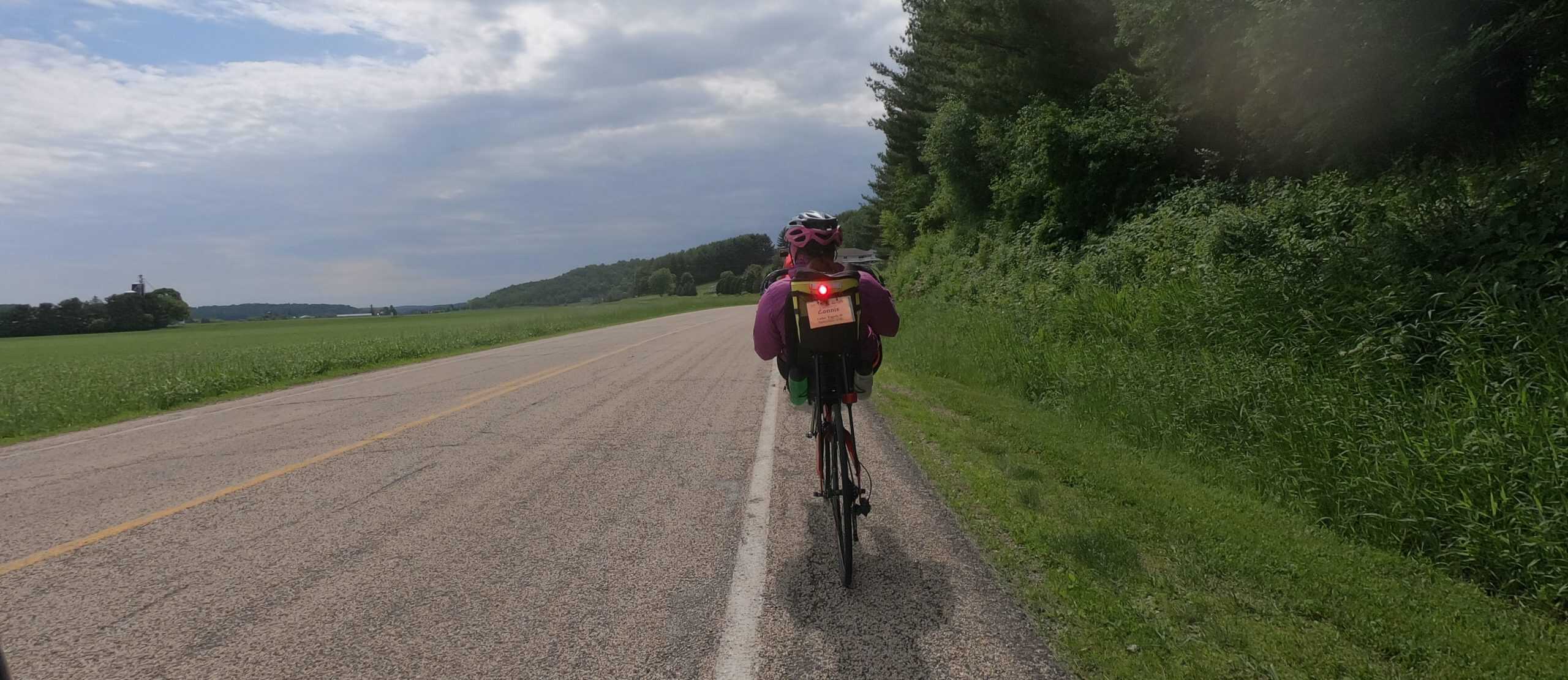
Here’s my own little study of how lights look on bikes during the day. They may or may not be visible under the bright summer sun, but they certainly suggest their benefit on wooded roads like in Barrington Hills, or anywhere as dusk approaches. You can compare steady and flashing lights, and even see one rider whose flashing taillight turns steady when she brakes.
Like this? Please consider a donation


