
Most recent and notable updates: Schiller Park law added June 19, 2026; Bloomingdale law added May 14. Wheaton law and note on state legislation added April 18, 2026. Riverside law added Feb. 4. This compilation of e-bike laws town-by-town began in the spring of 2025.
2025 was the year of new local e-bike laws. As e-bikes and other motorized two-wheelers like e-scooters and mini-bikes sped around in more locations, often ridden by children, residents became concerned about safety.
So municipalities and park districts responded with new rules or laws. They vary significantly. Some are strict and some only reiterate state law. Four towns outright ban e-bikes in public spaces. Read an analysis of the rules and how they evolved in 2025.
Under the leadership of Ride Illinois and the Active Transportation Alliance, state legislation has passed to distinguish e-bikes from “e-motos,” those other two-wheelers with bigger motors, so that e-bikes are given more freedom while e-motos are regulated more like motorcycles.
Here in a separate article is a breakdown of the state laws and regulations county by county. Then details on state law, the safety and legislative campaign at the state level, and e-bike laws suburb by suburb are below.
State law on e-bikes
Note: On June 1 the state Senate gave the final approval on legislation that would regulate e-motos and add a minimum age of 15 for Class 1 and 2 e-bikes. Gov. JB Pritzker is expected to sign it. Read more here.
State law considers e-bikes “bicycles,” as opposed to motorized vehicles. They must be “low-speed” with motor power of less than 750 watts.
The state allows e-bikes (as bicycles) on trails and bike lanes, as well as on roads where bicyclists are allowed, but not on sidewalks.
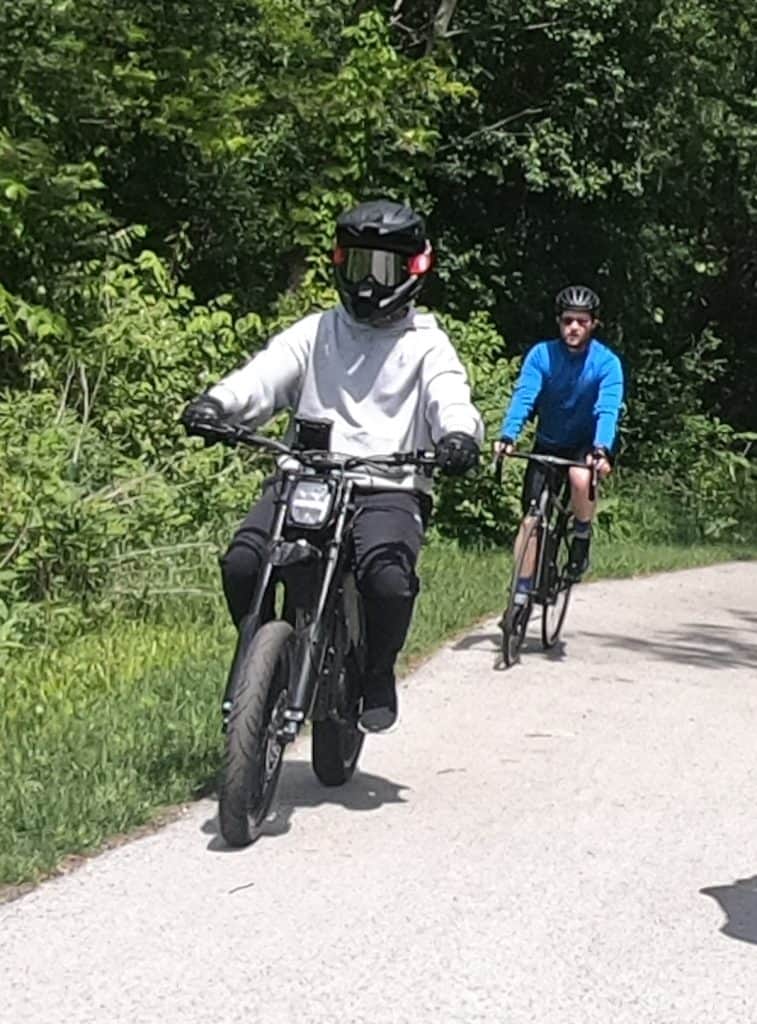
Then, e-bikes are divided into three classes in state law, as in much of the country:
Class 1: Bikes have a motor that provides assistance only when the rider is pedaling and maxes out at 20 mph.
Class 2: Bikes have a motor that can propel the bicycle without the rider necessarily pedaling and maxes out at 20 mph.
Class 3: Bikes have a motor that provides assistance only when the rider is pedaling and maxes out at 28 miles per hour. Class 3 riders must be 16 or older.
The state doesn’t require driver’s licenses for e-bicyclists. When some suburbs require a driver’s license to ride an e-bike, there’s no specific e-bike training as part of obtaining the license like there is with autos.
By the way, a state law on e-scooters went into effect in August 2024 saying they’re allowed only if towns allow them, they must max out at 10 mph, and e-scooter riders must be 18 or older. So each suburb one by one has had to decide whether to permit them.
There’s also state law on “gas-powered bicycles“: “A 2-wheeled or 3-wheeled device with fully operable pedals and a gasoline motor of less than one horsepower or 15 cubic centimeter displacement that is operated at speeds of less than 20 miles per hour.”
State campaign on e-motos vs. e-bikes
Secretary of State Alexi Giannoulias on Jan. 29 launched a “Ride Safe, Ride Smart, Ride Ready” campaign to update state law so that e-motos would be regulated separately from e-bikes, and to educate Illinoisans on the distinction.
The advocacy group Ride Illinois, which is part of the campaign, in 2025 began working to educate the public and elected officials on e-motos, the general term adopted for bikes that have a motor of 750 watts or more and can go more than 20 mph without pedaling.
Giannoulias’ website now includes a couple of web pages outlining the campaign in broad terms so far. The “Know the Rules” page expands on the different kinds of “micromobility” devices and indicates which are regulated. The campaign’s main web page also lists advice for bicyclists, pedestrians and auto drivers.
Meanwhile, Giannoulias says he’ll be working with educators, law enforcement and lawmakers to improve regulations and safety. Read more about the campaign.
Ride Illinois Executive Director Dave Simmons, who joined Giannoulias and the two lawmakers in announcing the state campaign, in 2025 lobbied suburbs to allow broader use of e-bikes after several enacted varying laws. He appeared on local TV news programs and debated the issue with the mayor of Elk Grove Village, the second Chicago suburb to require a driver’s license for e-bicyclists and where Ride Illinois is based, on a WBEZ segment. And he was quoted in local news articles like the Daily Herald and Axios Chicago.
A few suburbs heeded his advice and focused regulations on e-motos rather than e-bikes. But others continued adding e-bike restrictions beyond those in state law.

“We need to focus on a long-term solution, not this patchwork of ordinances that are just confusing the public and most likely resulting in more trips by car, which we all know is the real reason people are being seriously injured and killed on Illinois roads,” Simmons told Axios.
Ride Illinois has a web page with guidance for municipalities. It has urged local leaders to consider that age, disability, personal choice, low income and lack of other transportation options prompt some people to ride e-bikes. It also has encouraged responsible e-bike use, including wearing a helmet, using lights on the bike and watching speed, suggesting a 15 mph speed limit.
Ride Illinois and the Active Transportation Alliance hosted a webinar on the issue, now viewable on YouTube.
Wheaton requires licenses, age 16 for e-motos
The Wheaton City Council on April 6, 2026, voted to require riders of “out-of-class electric vehicles” — “vehicles similar to dirt bikes/motorbikes capable of higher speeds and with more powerful engines” than state-legal e-bikes — to be at least 16 years old and have a valid driver’s license. Such e-motos are allowed only on roads.
The city did not add any e-bike regulations in its “Keep it Safe, Keep it Legal” campaign. It’s emphasizing education, with the police department’s help.
“The Wheaton Police Department will be dedicating additional patrols to help educate cyclists, riders and others of the new ordinance, especially in the downtown,” the city said. Nothing with wheels may be ridden on downtown sidewalks.
“The Wheaton City Council, City staff and Wheaton’s Bicyclist and Pedestrian Commission have been collaborating to create an ordinance that prioritizes the safety of cyclists, pedestrians and motorists in a way that is understandable and emphasizes resident education,” the city said. More information will be coming, it says.
Harwood Heights, Norridge ban e-bikes in public places
The Harwood Heights Police Department posted on Facebook April 18, 2026, that the village bans e-bikes and e-motos in public places.
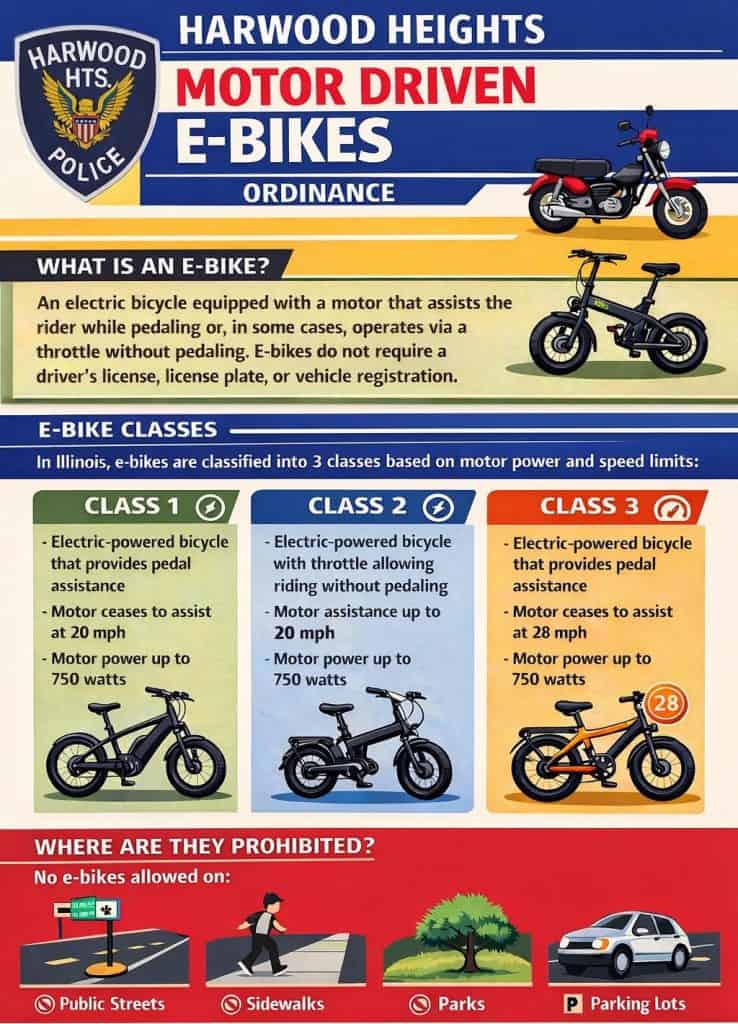
“Let’s clear this up so everyone’s on the same page,” the post began. “E-bikes are NOT permitted anywhere in Harwood Heights under our current ordinance. That includes streets, sidewalks, parks, and parking lots.”
“There are designated off road parks and areas where they can be used safely and legally,” the post said, encouraging a Google search to find them.
The post included a graphic defining legal e-bikes in Illinois, outlining the three classes, but then at the bottom it reiterated where they’re not allowed in Harwood Heights.
The village board appears to have approved the measure in July 2025.
Neighboring Norridge also has banned e-bikes from public places, according to the Harwood Heights police as well as the Norridge Park District.
“No Person shall drive, ride, or otherwise operate any minibike, trail bike, electric scooter, or any other motorized wheeled vehicle on District Property,” a park district web page says. “Park staff have been instructed to kindly ask and remind patrons, most often younger patrons, to return home with e-bikes, e-scooters, motorized bikes, and dirt bikes.” It says police could hold devices of youths who don’t leave until parents pick them up, and tickets could be issued.
Harwood Heights and Norridge join Glenview and Orland Park in banning all e-bike use in public places.
Schiller Park: License required, age 18 minimum
The Village of Schiller Park requires all e-bike and e-scooter riders to have a driver’s license and be 18 years old.
The village passed its ordinance June 26, 2025. It issued a reminder on its regulations May 26, 2026, via Facebook.
Its poster on the regulations includes a section on “why a driver’s license is required for e-bike and e-scooter use.”
“These motorized devices can reach significant speeds and require the same level of judgment, awareness, and responsibility as operating a motor vehicle,” the village says. “Requiring a valid driver’s license ensures that users have a basic understanding of traffic laws, roadway etiquette, and the ability to safely navigate shared spaces with vehicles and pedestrians.”
Riverside keeps e-bikes off bike paths
The Riverside village board on Dec. 4, 2025, voted to allow broad use of e-bikes, except in parks and village bike paths.
The village adopted the state vehicle code, which “allows citations and related matters to be addressed locally, rather than requiring individuals to appear at the Maybrook Courthouse,” the village’s web page on e-bikes and e-scooters says.
But village leaders insisted that e-bikes and e-scooters stay off sidewalks out of safety concerns, the Riverside-Brookfield Landmark reported. Village parks and bike paths became part of the restriction.
Fines were not outlined in the ordinance itself, and a provision allowing the village to impound vehicles was stricken in a draft. “For us, the education part is the most important key component, but, if necessary, enforcement action can be taken,” Public Safety Director Matthew Buckley told the village board.
The ordinance includes a provision to follow the state law, without future village board action, if the law changes in the future.
Arlington Heights adds age limits to law, with an exception
Arlington Heights trustees on Aug. 11, 2025, were considering banning anyone under 16 from riding e-bikes and e-scooters on sidewalks and streets, but they decided to ease the restrictions after adult advocates and some youths lobbied them, the Daily Herald reported.
So on the following Sept. 15, the trustees approved an ordinance that sets a minimum age of 16 only for Class 3 e-bikes as well as “out-of-class electric vehicles,” or e-motos, and permits anyone of any age to ride Class 1 and 2 e-bikes and other devices. Age 16 is already the minimum for Class 3 e-bikes under state law.
Now the village has changed course, adding age restrictions after all — though village leaders weren’t unanimous. Trustees on Nov. 17, 2025, approved an amended ordinance — after even further amending it beyond what was presented publicly — with a 5-3 vote.
And they still offered a way to avoid the age restrictions. Youths can just take a bike safety quiz. (Read more specifically about this provision.)
“During the (Sept. 15) discussion, Village staff indicated the ordinance provided a basic framework for the rules and regulations for these devices, but further review and research was necessary,” read a memo on the updated ordinance. “Staff liaisons consulted with numerous Village Boards and Commissions, including the Board of Health, Youth Commission, Senior Citizens Commission and Bicycle and Pedestrian Advisory Commission.”
New recommendations to add age limits based on speed constituted the latest proposal, first discussed by trustees Oct. 15.
Rather than assign limits to each kind of e-bike or any motorized device, the ordinance now sorts restrictions by how fast anybody rides any device, with the following labels:
- Low-Speed Mobility Devices (less than 10 mph): No age restrictions, and they could be ridden anywhere including sidewalks.
- Standard Mobility Devices (10–28 mph): Limited to those 18 and older, or to those 16 and 17 if they have a learner’s permit or driver’s license, or to anyone who achieves a level of “silver” or better on Ride Illinois’ bike safety quiz.
- And they could be ridden on streets, plus they could be used on shared-use paths at speeds of 15 mph or less.
- Out-of-Class Mobility Devices (greater than 28 mph): strictly prohibited on public ways.
The provisions in the “Standard Mobility” category about the shared-use paths and the Ride Illinois bike safety quiz exception to age limits were added the night of Nov. 17 at the suggestion of Trustee Wendy Dunnington, who was concerned about overly restricting e-bike use especially among students. A couple of residents had addressed the village board to also lobby for broader use.
But other trustees expressed concern about e-bicyclists and riders of other vehicles traveling on streets without knowing the rules of the road.
“It should be noted, amendments to the definitions of the devices as proposed do not generally restrict a person under the age of 16 to operate a Class I, II or III device per se, but rather restrict the speed at which that person may operate the device,” the proposal read in October. It suggested that some devices have settings to restrict the maximum speed.
That language means e-bikes of any class really could be used anywhere at any age if they’re ridden under 10 mph. Restrictions begin once any e-bike is ridden at 10 mph or faster.
The ordinance has a recklessness standard so that police could cite anyone operating any vehicle “with a conscious disregard for the safety of others and/or the operator.” Helmets also are required, plus riders must make sure they keep both hands on the handlebars even if they’re carrying something.
Police can impound the device and impose an administrative fee of $250 for its retrieval, and the fines for violations are $75 for the first offense, $150 for a second offense and $250 “for the third offense, or for reckless operation.” Parents also could be punished. An adult who violates the ordinance “in connection with the minor’s violation” may be fined as well as the minor.
Other provisions in the ordinance are aimed at safety while crossing sidewalks downtown. Another provision says no e-vehicle “shall be operated faster than is reasonable or proper.” Riders also must ride single file.
E-moto death in Arlington Heights
The Sept. 15, 2025, vote in Arlington Heights came on the same day a 16-year-old Mount Prospect boy died after crashing his e-vehicle into a pickup truck at a neighborhood intersection in Arlington Heights, the Daily Herald reported. Police said witnesses told them he was traveling on a vehicle going 30-40 mph, and his vehicle did not have a sticker denoting a legal e-bike.
Police said indications were the teen disobeyed a stop sign at the intersection, there was no stop sign for the pickup driver, and the teen was not wearing a helmet.
“My son Samuel Alfaro had a tragic accident. Samuel was a beloved son, brother, friend and teammate,” his mother, Sandra Acevedo, wrote on a GoFundMe online fundraising page. “Samuel was a proud Mustang Soccer player. His dream was to play soccer in college. We are completely devastated as a family.”
While some trustees on Aug. 11 had advocated for the original, tighter restrictions, trustees including Wendy Dunnington and Bill Manganaro responded to the concerns of about a half dozen speakers who said a fuller ban would impede transportation options for responsible operators, both youths and adults, the Herald reported.
“I do think that there are people that are riding responsibly and have a real need for these kind of devices,” Dunnington said. “They are good for the environment. It’s less trips in the car.”
Naperville imposes 16+ age limit for all e-bikes
The Naperville City Council on Dec. 2, 2025, approved an ordinance that imposes a minimum age of 16 for all e-bike riders, effective Jan. 1, 2026.
Naperville Police Chief Jason Arres said during a first reading of the ordinance Nov. 4 that youths’ being forced onto streets, since state law doesn’t let them ride on sidewalks, can create hazards for them and motorists, the Naperville Sun reported.
“We’ve seen a lot of dangerous situations that I believe is just the lack of experience with kids understanding the rules of the road,” Arres said.
Class 1 and 2 e-bikes will be allowed on city streets, and they’ll be allowed on city trails and paths with a speed limit of 15 mph.
Class 3 e-bikes will be allowed only on streets and in bike lanes “only if the bicycle lane is designated for speeds up to 28 mph or local signage allows.” No e-bikes will be allowed on sidewalks or the city’s popular Riverwalk.
City leaders said they wanted to keep the path restrictions consistent with those on trails in and surrounding Naperville managed by DuPage and Will counties.
The ordinance lists e-motos as an “e-motor or prohibited motorized device.” Those are “any two- or three-wheeled device with a motor exceeding 750 watts, lacking fully operable pedals, or capable of sustained speeds exceeding 28 mph without pedaling, including but not limited to motor-driven cycles, minibikes, or pocket bikes.”
“Such devices are not E-Bikes nor E-Scooters … and are prohibited from being operated on public streets, parks, Multi-Use Paths, or Sidewalks in the City of Naperville, unless appropriately titled and registered as motor vehicles and operated appropriately pursuant to state law,” the ordinance reads.
Legal e-bikes have motors of 750 watts or less, while e-motos typically are said to have motors of 750 watts or more.
The ordinance applies the same regulations to e-scooters that go up to 10 mph as it does to Class 1 and 2 e-bikes: allowed on streets as well as trails and paths, and not on sidewalks or the Riverwalk. But e-scooters will be “prohibited throughout the entire park system of the Naperville Park District.” It applies the state minimum age of 18.
E-scooters that exceed 10 mph are not allowed anywhere.
The law does not say helmets are required but that they’re “encouraged.” There are several other rules, such as no sirens or “oscillating red and blue lights” allowed, no headphones allowed, at least one hand required on handlebars even if carrying something, and only one passenger per vehicle.
Parents and guardians will be held liable for youths’ violations. The city could impound vehicles. Fines will be no less than $100 and no more than $500, and could be imposed for consecutive days.
The Naperville Park District has said Class 1 and 2 e-bikes, plus e-scooters and “electric skateboards” are allowed on park trails.
City leaders want to educate residents, including kids at schools and parents who might buy e-bikes or perhaps e-motos for their kids. “Parents are the people who are buying these things for their kids and letting them use it,” Councilman Patrick Kelly said, according to the Sun. Flyers have been drafted, and they could also be handed out at stores, Arres said.
Des Plaines: Council allows broad use, but e-bikes banned in parks
The Des Plaines City Council on Dec. 1, 2025, approved an ordinance that would allow broad use of e-bikes while virtually banning e-motos. The council debated the ordinance the previous Nov. 3 and Nov. 17.
The city council’s actions follow the Des Plaines Park District’s declaration on Sept. 25, 2025, banning e-bikes and other motorized devices on park property.
While aldermen expressed concern about e-bike riders speeding dangerously, they also said they didn’t want to overly restrict their use. Alderman Colt Moylan, for example, on Nov. 3 said he liked that e-bikes and e-scooters helped residents get around town, that there are no emissions, and that they help get kids off screens and out of the house.
“I understand that people might see a bike flying down the street that can make you pause and say, wow, we gotta restrict this, this is getting out of hand. But I think most times that’s really not the case,” Moylan said. “I think there’s a need to define and have an ordinance, but I think we have to be careful about this.”

But Alderman Thomas Merlin said he disagreed at least somewhat because he’s heard complaints of riders “flying down Howard (Avenue) on those things. They ignore stop signs, they ignore everything.”
“I like the idea of going lower at first, and if we have to, build it up,” Merlin said. “… We’re starting out with the carrot rather than the stick; I think that is important. But my concern is, somebody’s going to get killed.”
There briefly was discussion of age limits for e-bike riders, but in the end the ordinance did not add any beyond what the state already requires — a minimum age of 16 only for Class 3 e-bikes.
The proposed ordinance at first required all riders to wear helmets, but aldermen nixed that provision because, they said, they’re not required on traditional bicycles or even motorcycles.
Other provisions are listed, such as one requiring e-bicyclists to ride single file, as well as one to guide vehicles with both hands on the handelbars even when carrying something.
On e-motos, the ordinance says “it is unlawful for any person to operate an Out-of-Class Electric Vehicle on any public street, sidewalk, parking lot, bike path, or any other public property within the corporate limits of the City.”
Mayor Andrew Goczkowski said Nov. 3 he preferred to punish “bad behavior” rather than ban devices.
“I think it’s sometimes a little misguided to blanket ban these devices because they’re new and scary and people are calling,” Goczkowski said. “At the end of the day what we really want is responsible use of these things that people use.”
Aldermen also said they were worried about diverting police officers’ time. Police Chief Dave Anderson said the focus will be more on education than punishment, and that enforcement will be based on complaints.
Fines would be $75 for a first offense, $150 for a second offense and $250 for a subsequent offense “or for reckless operation.” Adults “who permit a minor under the age of 16 to violate” the ordinance also could be fined. Devices could be impounded, with a $250 fine required for their release.
The Des Plaines Park District declared its ban on e-bikes and e-scooters in a Facebook post.
“Due to safety concerns brought forward by our residents and staff, the Park Board of Commissioners has updated its ordinance banning the use of E-Vehicles, E-Scooters, and E-Bikes on its pathways, playgrounds, and open spaces,” the post read. No penalties or other provisions were listed.
Merlin argued banning the devices could push them onto the streets. “We have to find a happy medium,” he said.
Buffalo Grove: No Class 2’s or 3’s in parks, on paths
The Buffalo Grove village board approved a new ordinance Dec. 1, 2025, that allows broad use of e-bikes and e-scooters, following state law, except with some location limits on Class 2 and 3 e-bikes.
The village posted an impressive web page outlining the regulations in an easy-to-read format.
About e-bikes, the simple ordinance specifies only that “Class 2 and 3 e-bikes are not allowed on Village bike paths or in parks.” The ordinance focuses more on defining and limiting e-motos.
The park district is considering a matching ordinance at its Dec. 15 board meeting, a village news release said.
Fines can start at $100. A parent or guardian may be fined for a child’s violation. But Village Manager Dane Bragg said education will be more the focus among police, the Daily Herald reported.
“We’re not going to have police officers out writing $100 tickets willy nilly,” Bragg said. “We can educate children and parents about what the regulations are and get compliance that way.”
The village’s web page notes that Buffalo Grove School District 21 prohibits all e-bikes and e-scooters on campuses. Other school districts, such as in Schaumburg and Palatine, have done the same.
“While we recognize that e-bikes and e-scooters have become a popular mode of transportation for many, their presence on campus poses significant safety risks. These devices can travel at high speeds, are often difficult to control in crowded areas, and can cause serious injuries in the event of a collision,” the note on the policy says. “Additionally, our campuses are not designed to accommodate the storage, charging, or secure parking of these devices, creating further safety and logistical concerns.”
Buffalo Grove’s law also restricts e-scooters that can exceed 10 mph from sidewalks, paths, parks and parking lots.
Vernon Hills: Only Class 1’s in parks, village overall ‘more measured’
The Vernon Hills Park District on Oct. 13, 2025, posted a news release saying that only Class 1 e-bikes are allowed on its paths and trails.
It’s part of its “Our Paths are for Pedals” campaign that says basically no bike or device with a throttle — which includes Class 2 and 3 e-bikes — is allowed on park district property. It outlines those devices, which include “power-driven scooters” and “power skateboards.”
The Daily Herald reported that the campaign will include yard signs, flyers and postcards, the last of which police will help hand out. Social media and emails are part of the effort, too; the police department already has made a video.
Park district Executive Director Matt LaPorte told the Herald no accidents prompted the campaign. “We’re not really out there to have negative interactions,” LaPorte said. “We want to make sure we educate families before they purchase these devices before the holidays and they’re making the right choice.”
The Village of Vernon Hills overall has not enacted its own e-bike laws. On Aug. 14, 2025, it posted a notice reiterating only state law on e-bikes while saying “electric dirt bikes, ATVs and the like may only be operated on private property.” It said the village board and police leaders have been discussing options.
“While some communities have worked to create their own municipal regulations, the Village is taking a more measured approach at this time,” the notice said. “The goal is to educate users and guardians not only on what is allowed by regulation but what is safe and appropriate.
“Going forward, the Village will continue to work for overarching regulation developed at the State level to help guide all communities on these efforts.”
Palatine: Learner’s permit or license for ages 15, 16, 17
The Palatine City Council approved an ordinance Sept. 15, 2025, that allows e-bikes to be ridden only on village streets — not local paths or other public property — only by riders 15 and older, and there are restrictions for riders age 15-17.
E-bicyclists who are 15 can ride on streets only if they have a state learner’s permit, the precursor to a driver’s license. E-bicyclists age 16 and 17 must have a driver’s license.
E-bike riders 18 and older are not required to have a driver’s license.
The city first had proposed requiring a driver’s license for all e-bike riders, but on Sept. 2, 2025, the city council called for the revisions easing the license requirement.
Helmets and lights also are now required.
E-bikes are not allowed on paths within the suburb. They’re not allowed on sidewalks, either, as per state law.

The Palatine ordinance doesn’t actually distinguish between legal e-bikes, with motors of less than 750 watts, and e-motos, the vehicles with motors of 750 watts or more. Instead it refers to “untitled motor driven vehicles” that generally “can exceed 12 mph.” “Untitled Motor Driven Vehicle means any vehicle for which the State of Illinois does not issue a title document or issue license plates or registration documents,” the ordinance says. That includes low-speed e-scooters.
Fines begin at $50, but the city says a new fine structure may be forthcoming. Parents can be fined if their children violate the ordinance, and e-bikes can be impounded.
The city considered feedback from residents. “Restricting e-scooters and e-bikes from all bike paths, even for adults, makes absolutely no sense to me,” said one letter writer, who suggested a path speed limit instead. “Additionally, e-bikes and e-scooters allow people (of all ages) with more limited mobility to partake in outdoor activities that would otherwise be difficult for them, such as bike rides with friends, a scenic ride along a bike path through a park, etc.,” the same writer said.
Another letter writer pointed out residents who ride e-bikes or e-scooters to work. “I don’t think it’s fair to deny these folks access when they are in fact, just trying to work and live within their means.”
The city staff statement said “this is an issue that would ideally be addressed at a state-wide level but the General Assembly has not taken action and the safety concerns continue to rise.”
It also said the staff would educate the public on the new regulations over the course of the fall, in partnership with schools and the park district and using social media.
Hoffman Estates: Only Class 1, 2 e-bikes allowed for ages 16+
The Hoffman Estates village board on Sept. 15, 2025, passed an ordinance that allows use of Class 1 and 2 e-bikes just as broadly as traditional bicycles are allowed, but only for those 16 years old and over.
“All Class 1 and Class 2 low-speed electric bicycles shall be permitted to operate in the same designated streets, paths and locations as other bicycles,” the ordinance reads. But all riders must be at least 16.
“Any Class 3 electric bicycles are prohibited from use on any Village-owned, or controlled paths or sidewalks,” the law reads.
The proposal also said e-scooters going less than 10 mph should be prohibited from all streets, sidewalks and paths, while those going 10 mph or more should be allowed on streets but not sidewalks and paths. And riders of the faster e-scooters should be 16 years old.
The village staff said prohibiting the lower-speed e-scooters protects the village, which could be sued without protection from the Tort Immunity Act in the case of crashes if it allowed them.
The ordinance also says “users of Electric Scooters or Low-Speed Electric Scooters shall not be intended users of any portion of the Village’s transportation network.” Not calling e-scooter riders “intended users” protects the village in the case of crashes under the Tort Immunity Act, the village staff said.
“Once an Ordinance is adopted, the Village will start a communications effort to ensure the community is aware of the regulations,” the proposal reads. It says police could start issuing $50 fines for violators.
Village leaders took part in a Northwest Municipal Conference summit Sept. 22, 2025, to discuss e-bike ordinances, but they said wanted to approve an ordinance now anyway before any crashes happen, and they could amend the law if needed.
Northwest suburban leaders hold e-bike meeting
The Northwest Municipal Conference, a group of leaders from 43 municipalities and one township, held a discussion about e-bike, e-scooter and e-moto laws Sept. 22, 2025.
It wasn’t open to the public, but the Daily Herald reported on it, and the conference posted a video of it. The consensus was that clarity in state law about e-bikes vs. e-motos was needed.
“That’s the biggest problem right now,” Deerfield Deputy Police Chief Brian Budny said, “the confusion of what is what.”
“Multiple NWMC member municipalities have recently adopted ordinances regulating e-bike, e-scooter, and e-moto usage,” the conference said in a statement ahead of the meeting. “Many others are beginning the process considering developing their own. NWMC staff is working with member communities to better understand the factors contributing to the development of these ordinances.”
The group said it was hosting the discussion “in the interest of ensuring a more cohesive regulatory environment across the suburbs.”
Elected officials, transportation staffers, public safety staffers and industry experts were invited. So was a law firm, according to a Daily Herald report.
Conference Executive Director Mark Fowler told the Herald about 20 of the conference’s 43 municipal members have not yet made their own laws.
Dave Simmons, executive director of Ride Illinois, said suburbs that haven’t enacted their own e-bike laws should wait out the coming winter to see what the state legislature will do, the Herald reported. But Mount Prospect Trustee Terri Gens, chair of the conference’s bicycle & pedestrian committee, said that’s difficult advice to take for officials responsible for public safety.
Mount Prospect: Age limit added for Class 2 e-bikes
The Mount Prospect village board on Oct. 7, 2025, passed an ordinance that follows state law on e-bikes except to add a minimum age of 16 to riders of Class 2 e-bikes.
The law otherwise allows broad use of e-bikes throughout the village, except that Class 3 e-bikes can’t be used on paths.
“The proposed ordinance allows Class 1 and Class 2 e-bikes (those with amaximum assisted speed of 20 mph) on roads, bike lanes, and shared-use trails,” read a staff cover sheet on the proposal in September. “Class 3 e-bikes (those with a maximum speed of 28 mph) would be permitted on roads and bike lanes. None of the three classes of E-Bikes would be allowed on sidewalks.”
The board first discussed the ordinance on the previous Sept. 16. The proposal at that time placed the age limit only on Class 3 e-bikes, as state law already dictates.
The ordinance also defines and essentially prohibits e-motos. It classifies e-motos as “motor driven cycles or motor vehicles,” meaning driver’s licenses and other things that the state requires of auto drivers would be needed.
“Lacking the requirements outlined in the Illinois Vehicle Code, these vehicles are strictly prohibited from operating within the Village,” the cover sheet read on Sept. 16. “This measure will help ensure responsible use and enhance the safety of our streets for all residents.”
The ordinance addresses e-scooters as well.
“Low-speed e-scooters (with a maximum speed of 10 mph) would be permitted on roads, bike lanes, shared-use trails, and sidewalks, except in the designated Downtown Area, where e-scooters would not be allowed on sidewalks,” the proposal read in September. But e-scooter riders would have to be at least 16 years old. In October, a separate category simply called “e-scooter,” for those going up to 20 mph, was added, with the same regulations.
Meanwhile, e-bikes would be prohibited from parking decks. And e-bikes and low-speed e-scooters would be “strictly prohibited from operating on any County or State highway (examples include Northwest Hwy, Elmhurst Rd, Algonquin Rd),” according to the first draft of the ordinance.
The village board raised the minimum fines between September and October, after one trustee said he thought the fines weren’t big enough, the Daily Herald reported. Fines for any violators could range from $75 (not $50) to $500.
Parents can be held liable for violations by their children, with fines of at least $200 (not $100 as originally proposed). Police can impound e-bikes and e-scooters, with a $150 fee required to retrieve them.
A recklessness provision also was added in the final ordinance.
“By learning from the experiences of our neighboring communities, the proposed ordinance seeks to avoid a complete ban, which would limit the convenience and accessibility these devices offer, while also mitigating the public safety concerns that arise from unregulated use,” the staff cover sheet read on Sept. 16.
Prospect Heights: E-bikes, gas bikes OK on city streets
Prospect Heights is allowing e-bike use on city streets, plus it’s permitting gas-powered bikes on city streets if they go less than 20 mph.

In fact, the Prospect Heights city council on Sept. 25, 2025, approved an ordinance only with specifications about gas-powered bikes. Then on Sept. 30, it issued a news release outlining rules on e-bikes and low-speed e-scooters that mirror state law, while also listing rules on the gas bikes that also mirror state law.
The differences are only Class 3 e-bikes have an age limit (of 16), while all gas bike riders must be 16 and all e-scooter riders must be 18, again all per state law.
The full ordinance on the gas-powered bikes has many details, such as not to disobey no-turn or no-U-turn signs, not riding them while drunk or high, not riding the bike at “a speed that is greater than reasonable,” yielding to pedestrians when approaching a sidewalk, always keeping at least one hand on the handlebar, not using a cellphone while riding, and not parking the bike on a street.
The ordinance pulls the state’s definition of gas-powered bikes as those with “fully operable pedals and a gasoline motor of less than one horsepower or 15 cubic centimeter displacement,” with a maximum speed of less than 20 miles per hour.
“Electric bicycles, gas-powered bicycles, and low-speed electric scooters provide numerous benefits, including reduced traffic congestion, lower carbon emissions, and enhanced mobility options,” Police Chief Milorad Derman wrote in a memo to the city council. “However, their growing presence on our roads and pathways has also raised concerns regarding safety, appropriate usage, and the potential for conflicts with pedestrians and traditional cyclists.”
The ordinance says parents could be penalized if their children under 16 break the law. Fines could range from $75 to $750, and a gas-powered bike could be impounded upon a third offense within a year, with a $250 fee required to get it back. But the city allowed a “warning period” to raise awareness in October, while “enforcement begins” Nov. 1, 2025.
The ordinance doesn’t say whether e-bikes could be impounded.
Since the city says e-bikes are allowed only on city streets, we presume that they’re not allowed on the Prospect Heights Trail that goes through town.
St. Charles: Allows broad e-bike use
The St. Charles city council on Oct. 6, 2025, passed a new ordinance that would largely follow state law on e-bike use. The city created a thorough web page outlining the regulations.
The city is allowing e-bikes on streets, bike lanes and bike paths, and not on sidewalks as per state law. Riders of Class 3 e-bikes would have to be at least 16; that also mirrors state law. The proposal discussed in September suggested the city is following recommendations from Ride Illinois.
The proposal allows non-motorized bicycles on sidewalks except in the downtown. “Low-speed gas bicycles,” operating at speeds of less than 20 miles per hour, are allowed in the same places as e-bikes, but riders would have to be at least 16.
The city is allowing the use of e-motos only by riders who are at least 16 and have a driver’s license, and only on streets.
Low-speed electric scooters, with a maximum speed of 10 mph, would be allowed on sidewalks, bike lane and bike paths, not on streets. High-speed electric scooters would be allowed only on streets. Riders of either would have to be at least 18 years old.
The law specifies, citing state law, that riders should indicate with hand signals that they’re turning or stopping, or give “audible signals” such as verbal warnings when approaching others. Rules on parking are included, as is a provision saying riders can roll only a maximum of two abreast on city streets.
In addition to requiring nighttime lights and of course brakes as per state law, a bell also would be required on bicycles; that’s not in state law but is recommended in Illinois’ Bicycle Rules of the Road.
Fines are $25 for a first offense, $50 for a second and $100 for a third, and anybody with a third or subsequent offense must take part in the city’s adjudication process. A maximum fine of $250 can be levied, or a violator could do community service.
Parents of violators 17 and under would be notified and a fine also possibly issued to them.
Economic Development Director Derek Conley, who presented the ordinance changes in September, said education will be emphasized, the Daily Herald reported, and the St. Charles Business Alliance is considering choosing bicycle safety for its next campaign.
Rolling Meadows: Follows state law on e-bikes, bans e-motos
Rolling Meadows followed Ride Illinois’ call for restraint on laws by permitting e-bikes throughout most of the suburb while not allowing “e-motos” on any public land.
The new ordinance, approved by the city council Sept. 9, 2025, says e-bikes can be used on “any highway, street, or roadway in the City authorized for use by bicycles, including, but not limited to, bicycle lanes,” plus “any bicycle path in the City.” But not on any sidewalks. It exactly follows state law on e-bikes.
The ordinance also prohibits e-motos, the devices with motors of 750 watts or more, on any public property in the city. “No person shall operate a motor driven cycle (as defined in Section 1-145.001 of the Illinois Vehicle Code …), e-moto, minibike or pocket bike upon any public street, sidewalk, parking lot, bike path, park or on any other public property,” the ordinance reads.
A presentation in August 2025 defined and warned against e-motos. “They are often considered e-bikes, but do not fit the classifications noted earlier,” referring to the legal Class 1, 2 and 3 e-bikes.
The draft of the ordinance had also said that e-bike riders must wear a helmet. The city council, in a 4-3 vote, removed that requirement in an amendment Sept. 9, following state law and the recommendation of Ride Illinois, according to Alderperson Kevin O’Brien. The vote on the overall ordinance was 6-1.
The fines for violations are $50 for the first offense, $100 for the second, $500 for the third and $750 for any further violation. Police can impound the e-bike, and parents or guardians could be penalized for their children’s violations.
Libertyville: E-bikes not allowed in parks, downtown
The Libertyville village board on Aug. 26, 2025, adopted an ordinance to prohibit e-bikes and e-scooters from village parks and downtown.
The police department promoted the decision in a Facebook post. The village memo on the ordinance said non-motorized bicycles already were not allowed downtown.
“This amendment is recommended to add the prohibition of electric bicycles and scooters due to increased safety concerns within the zoning district,” it said.
The village imposed no other restrictions on e-bikes.
Glencoe: Age 16, driver’s license required
Glencoe passed an ordinance Aug. 20, 2025, limiting e-bike use to those age 16 and older who have a driver’s license (or accompanied by an adult), and only on roads. The law took effect the following Sept. 1, a village web page says.
The village lumps e-bikes with e-motos in applying the restrictions, even as it defines legal e-bikes separately, following state law.
The age minimum is 18 for e-scooters, though a driver’s license is also required.
E-bike and e-scooter riders must wear helmets, no matter how old they are. Parents can be held liable for their children’s violations.
The web page alludes to fines but does not specify them.
Evergreen Park: Age limits, driver’s licenses, no paths
Evergreen Park on Aug. 18, 2025, passed an ordinance requiring that all e-bike riders be 16 or older and have a driver’s license, and they’re not allowed on village sidewalks or paths.
Nor are e-bicyclists allowed on any streets with a speed limit over 25 mph, and “they may not be used to cross or travel on higher-speed streets,” the village’s notice says.
That notice specifies that low-speed e-bikes and e-scooters “may not be operated on sidewalks, bike paths, walking trails, public parking lots, public parks, or parkways in the Village.” It says the exact same thing about high-speed devices, thereby lumping legal e-bikes with those not fitting in the state’s three categories.
The 25 mph street limit is lower than the more common local laws restricting e-bikes to streets with a 35 mph speed limit or lower.
The age restriction comes regardless of the class of e-bike, despite the state law restricting age only on Class 3 e-bikes.
E-scooter riders must be 18, following state law, and also have a driver’s license.
“E-bikes and e-scooters must be equipped with working brakes, lights, and reflectors for nighttime operation,” the village says. The full ordinance reflects state law on lights.
The full ordinance also warns against carrying any load that inhibits safely operating the e-bike or e-scooter, and against being distracted with a cellphone.
Fines can range from $100 to $1,000 per offense, per day, the full ordinance says.
Morton Grove: Age 16, driver’s license required
Morton Grove passed an ordinance Aug. 12, 2025, requiring e-bike riders to be 16 and older and have a driver’s license, unless accompanied by an adult.
Where e-bicyclists will be allowed to ride varies based on the class of e-bike.
Class 1 e-bikes can be ridden on sidewalks and streets, making Morton Grove one of the few suburbs explicitly allowing e-bikes on any sidewalks.
But Class 2 and 3 e-bikes are allowed only on village streets.
The ordinance distinguishes “low-speed e-scooters” from “electric scooters,” 10 mph being the threshold. The low-speeds are allowed on sidewalks only, while the faster scooters are allowed only on streets.
E-bike and e-scooter riders must wear a helmet. And parents can be held liable for children who violate the local law.
The village lists “ATVs, golf carts, minibikes, go-carts, motorized skateboards, one- & two-wheel self-balancing devices, etc.” as “prohibited vehicles.”
Police can impound vehicles up to 60 days, and fines could run up to $500. The village issued the ordinance in a graphic PDF.
Carol Stream: Age limits, driver’s licenses, no paths
Carol Stream on Aug. 8, 2025, passed an ordinance requiring that all e-bike riders be 16 or older and have a driver’s license, and they’re not allowed on village sidewalks or paths.
E-scooter riders must be 18, following state law, and also have a driver’s license.
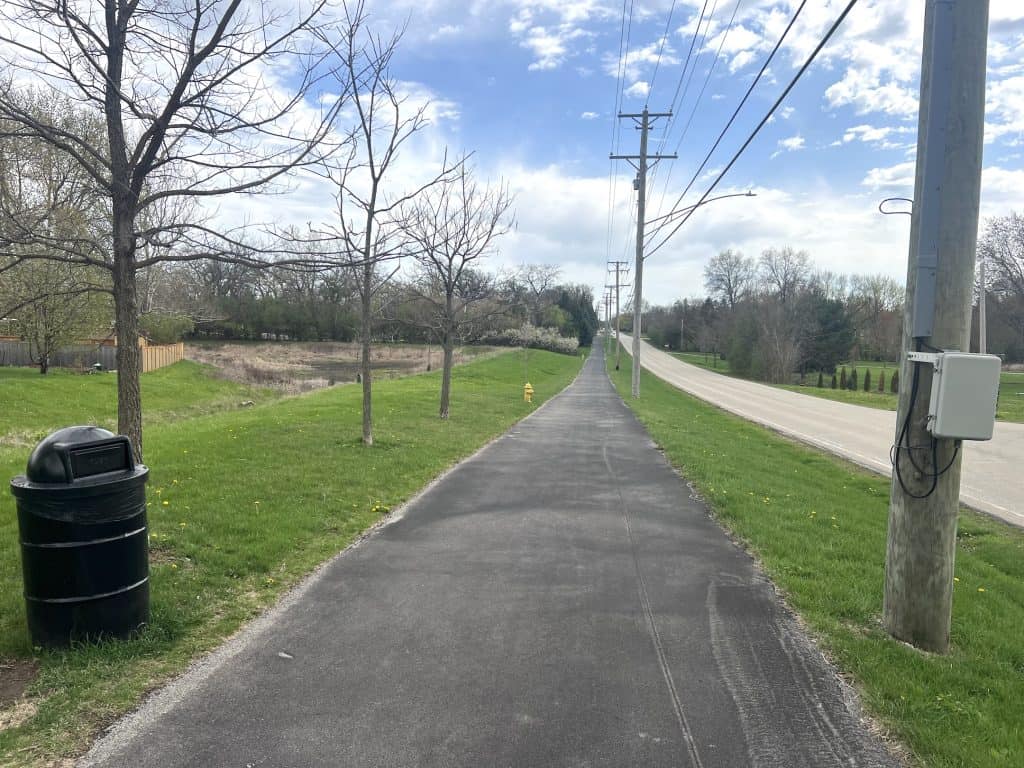
Banning e-bicyclists from paths is significant in Carol Stream as its bicycle infrastructure relies heavily on paths, such as on Fair Oaks Road, Lies Road and Kuhn Road. It does not have bike lanes, but neighborhood streets usually are light on traffic and wide.
Indeed, the ordinance specifies that e-bikes and e-scooters are allowed on streets with a speed limit of 35 mph or less.
The village on its website has a warning for parents: “Parents Take Note: Parents or guardians can be cited for violations committed by their juvenile children when operating these devices within the Village.”
A brochure from the village also notes the requirements for lights, with an option for a rear reflector in place of a rear light per state law, on e-bikes at night. And it notes the fines of $50 for a first offense, $100 for a second offense and $200 for the third and subsequent offenses. Both a juvenile and a parent could be fined.
The brochure also warns, “No stunts, crowd weaving, or excessive speed. No handheld phone/device use while riding. No carrying items that impair control.”
Orland Park: No e-bikes on any public land
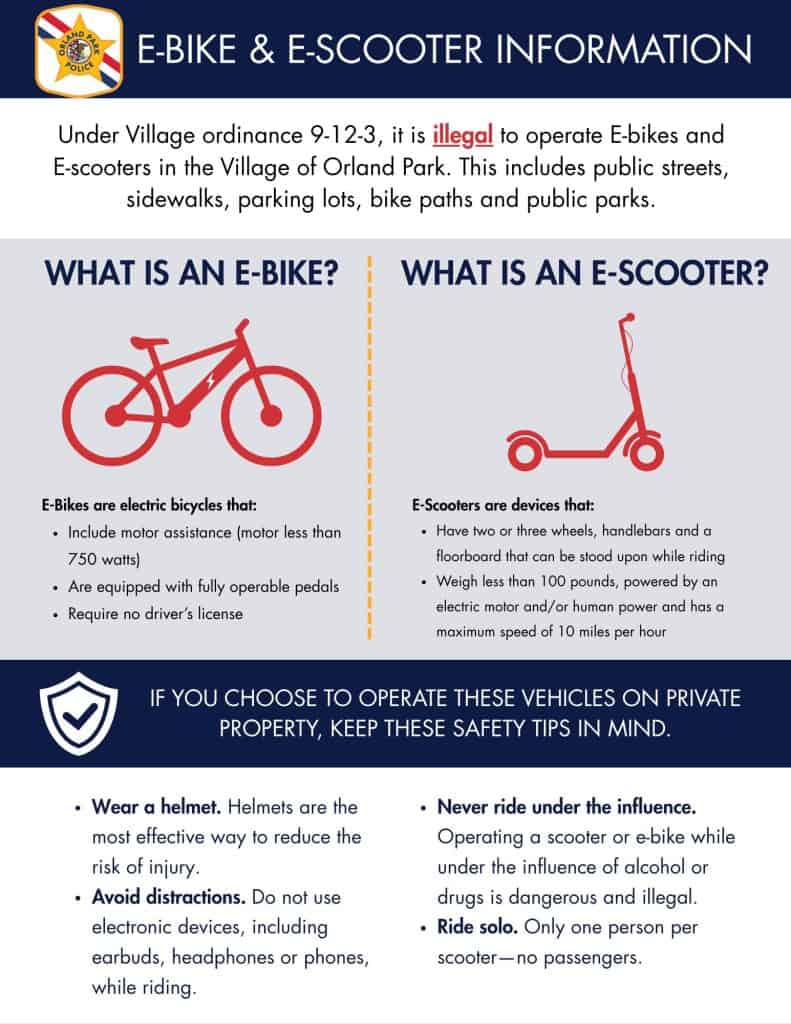
Orland Park in late July 2025 announced a ban of e-bikes and e-scooters on all public property.
“It is illegal to operate E-bikes and E-scooters in the Village of Orland Park,” it said in a Facebook post. “This includes public streets, sidewalks, parking lots, bike paths and public parks.”
The post did not mention fines. The village has not posted anything about the ban on its website.
The Facebook post does encourage helmet use by those riding on private property. It also says to “never ride under the influence.”
“Please note that throughout the summer, police officers will increase safety education and enforcement efforts to help keep our E-bike & E-scooter riders and community members safe,” the Facebook post said.
Hanover Park: Age, location limits, and no e-scooters
Hanover Park is joining other suburbs in setting an age limit of 16 for e-bike riders and prohibiting e-bikes from any village paths. And it is banning e-scooters from the village entirely.
The village had on its Aug. 7, 2025, village board consent agenda, for approval without discussion, a new e-bike and e-scooter ordinance. The ordinance first of all says riders of e-bikes must be at least 16 years old.
But e-bike riders can be under 16 if they don’t use the electric assistance, under the ordinance.
E-bike riders would be prohibited from “any public sidewalk, bicycle path, or multi-use path or on any other public property or public way where the use of motor vehicles is not permitted,” unless, again, they don’t use the electric motor.
As for e-scooters, “low-speed electric or motor-driven scooters, and motor-driven cycles are prohibited for use in the Village,” the ordinance reads. Any bikes with motor power of 750 watts or greater also are altogether banned.
The ordinance also holds parents accountable: “It shall be unlawful for a parent or legal guardian to allow a minor under his or her direct control or with his or her consent to violate this section.”
Penalties for violators or parents were not specified.
Park Ridge: Varying age limits after debate
It took some debate and a few City Council votes, but Park Ridge passed an ordinance July 21, 2025, that set e-bike age limits depending on the class of e-bike.
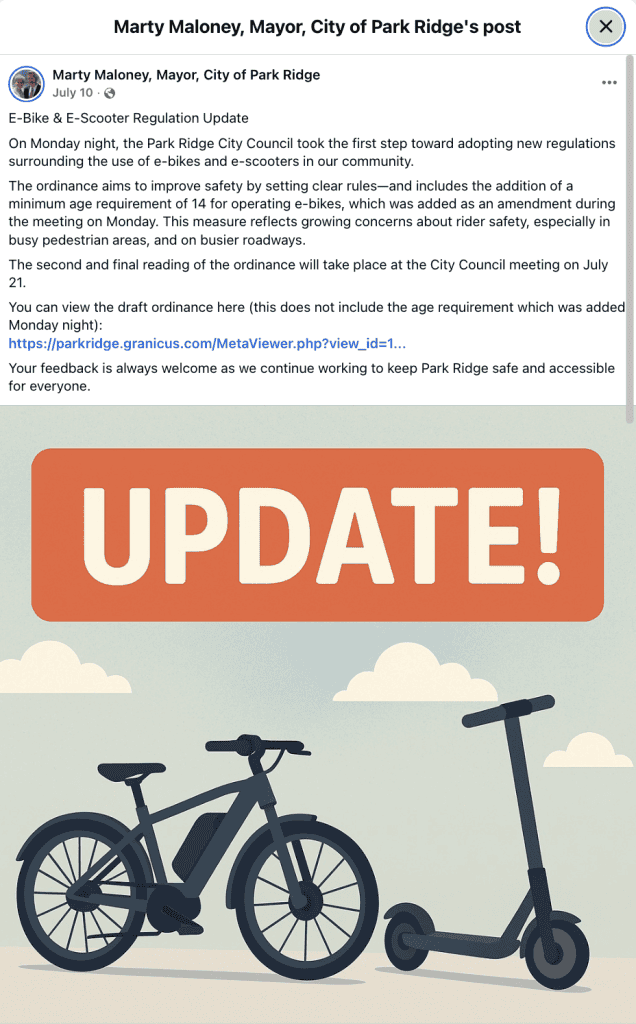
The city says riders must be at least 14 years old to operate a Class 1 or 2 e-bike, and 16 years old to operate a Class 3 e-bike.
Park Ridge is largely following state law, including that banning e-bikes from sidewalks and requiring lights at night and labeling, but it’s allowing e-scooters on sidewalks. Still, the city specifies further sidewalk restrictions: “Electric mobility devices are prohibited from use on sidewalks in several high-traffic areas, including Uptown, South Park, and the Higgins Corridor. They are also prohibited on all property owned by the Park Ridge Park District, School District 64, and School District 207.”
The city also says “e-bikes and -scooters may be parked on sidewalks where they do not block pedestrian access and must not obstruct roadways or public spaces.”
Alderpersons had debated the age restrictions, considering a minimum age of 16 for all e-bike users, before settling on age 14 for Class 1 and 2 e-bicyclists.
A draft of the ordinance said police could “give verbal notice of the violation” to parents of underage e-bicyclists, or refer the juvenile “to an alternative, non-court program.” Plus violators could be fined between $25 and $50 per offense.
Highland Park: Age, license, road-only rules
The City of Highland Park on June 16, 2025, enacted strict regulations that require e-bike riders to be 16, have a driver’s license, wear helmets and ride only on roads, not sidewalks or even bike paths.
The new ordinance prohibits e-bikes and e-scooters “on sidewalks, bike paths, and other public property such as parking lots, bicycle paths, and trails,” including public parks. And “parents or guardians may be held responsible for minors.”
E-bike riders must be 16 and hold a valid driver’s license, and a parent or legal guardian must accompany children under 16 or who do not have a valid driver’s license, the city says. It’s age 18 for e-scooter riders, matching the state’s minimum age for those riders.
Helmets also now are required for all riders.
The city says the city council will consider a minimum fine for violators of $100.
“The city has experienced a rise in safety concerns regarding e-bikes, e-scooters, and similar vehicles,” a city FAQ says. “These concerns included reports of unsafe operation and general safety issues, a traffic crash that resulted in injuries requiring hospital treatment, unauthorized use in parks and trails, and hazardous operation within business districts.”
E-bikes also must have lights at night consistent with state law, which is a white light on the front visible from 500 feet, and a red rear light visible from 500 feet or a red reflector visible from 50 to 600 feet.
Why so many restrictions? “E-bikes and e-scooters can reach high speeds, particularly relative to pedestrians in shared spaces like parks and trails,” the city says. “These vehicles are often difficult for drivers and pedestrians to detect, particularly at speed, which can result in more serious injury to the rider or pedestrian in the event of a collision.” The city also says they’ve been a problem in parking lots.
One council member, Jon Center, voted against the ordinance, according to the Lake County News-Sun. He said he feels the ban is overly broad and will have “unintended consequences” for community members besides “irresponsible youths,” such as older residents “who enjoy riding bikes on these paths.”
Schaumburg: Age and location limits
The Schaumburg village board in June 2025 passed a new e-bike ordinance limiting the age of all e-bike riders and where e-bikes can be ridden.
The ordinance first of all says riders of e-bikes must be at least 16 years old. Then the ordinance says all e-bikes, even those running up to 28 mph, can be used on paths and streets, unless signs indicate otherwise. That’s consistent with state law. Electric scooters that go no faster than 10 mph are banned from village streets, however.
And no e-bikes of any class and no e-scooters can be ridden on sidewalks. Plus, the village is requiring e-bike and e-scooter riders to wear helmets.

The village cites state law noting that any e-bikes that can go faster than 28 miles mph or are equipped with a motor of 750 watts or more are motor vehicles, meaning their drivers must have licenses as car drivers do.
A headlight and taillight on the e-bikes and e-scooters are required at night, following state law.
Riders breaking the rules can be cited by Schaumburg police and fined up to $500 based on the number of offenses, and “riders committing reckless conduct can have the device impounded for a period of up to 60 days, along with additional fines issued,” the village’s newsletter said June 13.
But Mayor Tom Dailly told the Daily Herald the new regulations are an opportunity for greater education rather than vehicle pursuits and an influx of fines. “No matter what we do, enforcement is going to be difficult,” he said.
About parents of e-bike riders, the village said only that “parents/caregivers are responsible for ensuring their children understand traffic safety and are following both state and local laws.”
E-bike users, often children, are often seen zooming on bikes of various kinds on sidewalks, streets and paths. Sometimes official bike paths in the village look like sidewalks, possibly adding to the confusion.
The village’s Transportation Committee took up the matter earlier in 2025 after recommendations from the village staff, but it called for revisions after concerns about enforcement. The three-person panel on June 3 recommended the resulting revisions to the village board, which approved them June 10.
Fox Lake: E-bikes on roads only, with license and insurance required
The Village of Fox Lake on July 22, 2025, enacted a new ordinance prohibiting e-bikes or e-scooters “capable of exceeding 10 mph from sidewalks or pathways,” a news release from the police department says. And e-bike riders must now have a driver’s license and their bikes insured, with proof of insurance kept on the bike, in order to use roads.
“E-bikes and e-scooters incapable of exceeding 10 mph are allowed on sidewalks on paths, provided that they will yield to pedestrians and any vehicle as decribed in the Illinois vehicle code,” the village release says.
E-bikes tend to be able to exceed 10 mph, unless they’re small toys for children, so the law effectively bans e-bikes from sidewalks or local paths. And the insurance requirement is a new wrinkle.
First-time violators will be fined $75. A second violation will result in a $150 fine and the e-bike or e-scooter impounded. Third and further violations will bring a fine of between $350 and $750, plus impoundment.
The village reiterates that no low-speed e-bike is allowed on roads with speed limits over 35 mph, per state law.
Bloomingdale: Only Class 1 e-bikes on park paths
The Village of Bloomingdale enacted an ordinance in May 2025 that allows all classes of e-bikes but only Class 1 e-bikes on park paths, the police department has said.
The police department reminded on Feb. 16, 2026, that the legal e-bikes as defined by the state may be ridden on roadways, with only Class 1’s allowed on park paths, too — and not on “grass athletic fields and landscaped park property.”
“Electric dirt bikes, modified bikes, and devices over 750W are **not legally e-bikes** under Illinois law,” the police said. “These vehicles are prohibited on public streets, sidewalks, and other park property and are subject to enforcement action.”
“Our goal is education, and voluntary compliance,” the police post said. “However, due to the increase in complaints and safety concerns, officers will be conducting enforcement in parks and neighborhoods as activity increases.”
The police department posted a video in April 2025 of an e-moto rider on a sidewalk, calling the riding illegal.
Roselle Park District: Class 1 e-bikes only, with age limit
The Roselle Park District board in late April 2025 approved regulations restricting e-bike use by class, age and location. It has been publicizing them on social media, including with the police department’s help, and once on at least one large sign, in Clauss Park off Mensching Road.
The park district says only Class 1 e-bikes — the versions that can go up to 20 mph only by pedaling — are allowed, and only on designated trails and paths. And their riders must be 16 or older, contrary to state law that has no age limit for Class 1.
Non-electric bicycles also are allowed, regardless of age of the riders. ADA mobility devices are allowed in all areas.
Class 2 and 3 e-bikes are not allowed at all in the parks, nor are e-scooters, or gas-powered bikes or scooters. The rules are outlined on a park district web page, too.
The park district says people can report violators to the police by calling 911. The initial fine is $35, going up to $70 if unpaid for 14 days, and up to $250 if hearing dates are missed.
Roselle at large: Age restrictions with motor assistance
The Village of Roselle at large, meanwhile, approved an ordinance June 23, 2025, with restrictions on e-bikes just beyond the state’s restrictions, notably setting an age limit for riders using any motor assistance on e-bikes.
Riders now must be 16 or older to ride e-bikes with motor assistance. But e-bicyclists under 16 can ride Class 1 and 2 e-bikes as long as they use pedal power only, the village says. It reiterates that Class 3 e-bike riders already must be 16 or older, per state law, and no e-bikes can be ridden on sidewalks.
“The top safety concern we have with e-bikes is younger riders operating them in an unsafe manner, and the use of motor-assisted speed is a big part of the problem,” Roselle Police Chief Rob Barreto said in a news release. But he told the Chicago Tribune that his department was “leaning on education” instead of punishment.
E-scooters are allowed on streets with a speed limit of less than 35 mph. Only one rider may be on each e-scooter.
The village also is holding parents accountable. Roselle police can issue tickets to both children and parents, and impound the e-bike or e-scooter. Fines start at $35, with a hearing at village hall required.
Elk Grove: Driver’s license required, no motors on paths
All Elk Grove Village e-bicyclists are required to have a driver’s license on village streets effective July 1, 2025, and e-bikes can be ridden on local paths only with pedal power, no motor assistance.
The Elk Grove Village village board on June 17 of that year adopted new regulations that “aim to better align the responsibilities and requirements for riders of electric bike and electric scooters with drivers of other motorized vehicles,” according to a village web page.
The village says the e-riders can go only on roads with a speed limit of 35 mph or less. Also, “e-bikes and e-scooters shall not be used while distracted (e.g., using a phone, carrying anything that prevents control such as a package or other objects, etc.),” the village ordinance says.
E-scooters must have a brake, the village says. That’s not specified for e-bikes, apparently presuming they will have brakes. Also, e-bikes and e-scooters must have a front light and a rear light or reflector at night, as per state law.
The new ordinance says e-scooters may be used on public sidewalks “in a safe manner while obeying signs and signals and yielding to all vehicles and pedestrians.”
The village in its announcement of the new ordinance didn’t explicitly address e-bikes on sidewalks, but on Facebook the village account said: “State law prohibits the use of E-Bikes in any form from using public sidewalks. However, on multi-use paths and bicycle paths, E-Bikes may be ridden as regular bikes without power assist.”
Elk Grove police can ticket violators, with fines up to $200; “additional fines may apply for other violations or offenses.” Then the village ordinance says any violators under 18 must be picked up by a parent or guardian after police stop them, or violators will be held at the police station until they’re picked up.
Finally, the village says: “Please note that under the Illinois Vehicle Code, off-road vehicles such as electric dirt bikes, off-highway motor bikes, and all-terrain vehicles may only be operated on private property with the permission of the property owner. Individuals who use these on public property, including on sidewalks, parks, and streets, are subject to ticketing and fines.”
Streamwood: Stronger enforcement
Neighboring Streamwood early in 2025 added regulations to strengthen enforcement of state laws that prohibit motorbikes known as “mini-motorcycles” and “pocket bikes” from operating on village streets.
The new rules came in response to residents’ complaints about violators.
Hinsdale: Reiterates state law, warns of engine sizes
The Village of Hinsdale in May 2025 updated its local ordinance to reiterate state law on e-bikes and clarify its rules on e-scooters. Its focus for e-bikes is on the engine size.
“In order to be considered a legal low-speed electric bicycle, it must be equipped with pedals and an electric motor with a power output of less than 750w, as cited by Illinois State Law,” it said in a notice. “Only bicycles or legal low-speed electric bicycles, and adults on low-speed scooters can share the roadway with motorists in Hinsdale.”
The village warns of misleading e-bike sales. “Be aware of deceptive advertisements from manufacturers that promote their products as ‘electric bicycles.’ If a product is equipped with a motor output of 750w and greater and has two wheels, it is no longer considered a bicycle … . These products are considered dirt bikes, motorcycles, or, in some cases, a motor vehicle, despite its ability to be pedaled.”
The village is not allowing e-bikes on sidewalks, nor is it putting any age restrictions on them. It’s sticking to the state law.
The village has decided to allow e-scooters on sidewalks and side streets, but not in its business district or Ogden Avenue and 55th Street. E-scooter riders must be 18 years old as per state law, and they can go only up to 10 mph.
“An ordinance fine for a e-bike citation or scooter citation could be up to $750,” Hinsdale Police Deputy Chief Tom Lillie told ABC 7 Chicago, which reported that the village has issued 150 citations so far.
Glenview: No e-bikes allowed
Glenview issued a news release on June 23, 2025, saying e-bikes and e-scooters are not allowed on any public property.
“Per Village ordinance: Electric bikes and scooters are not permitted on public streets, sidewalks, parking lots, bike paths, or any other public property,” the release says.
Then the news release lists safety tips for e-bike and e-scooter riders “where permitted.”
Glen Ellyn: Not on downtown sidewalks
Glen Ellyn adopted an ordinance April 28, 2025, clarifying where e-bikes and e-scooters can be used and parked.
It allows bicycles including e-bikes, plus e-scooters, on all village streets and sidewalks, except downtown sidewalks.
Then the village says the bikes and scooters must be parked “in designated racks or on sidewalks next to buildings within 2.5 feet of wall.” And riders “must use racks only whenever possible in the downtown.” It specifies that riders can’t cling to vehicles.
The village is not allowing e-scooters, which it calls “personal mobility devices,” on roads with a speed limit of 35 mph or more.
Otherwise the ordinance follows state law on age restrictions: 16 and older for Class 3 e-bikes, 18 and older for e-scooters.
Deerfield: Addressing e-scooters more than e-bikes
Deerfield passed an ordinance in May 2025 that addresses motorized vehicles not requiring a license plate or license, including e-scooters, while saying little about e-bikes.
E-scooters, even ones that max out at 10 mph, are not allowed on sidewalks, bike paths, and public property or lots, the law says. That’s true of toy vehicles, too.
The ordinance notes the age limit of 18 for e-scooter riders. It holds parents responsible for children not following the regulations, with fines up to $100.
On e-bikes, Deerfield reiterates state law, including no e-bikes on sidewalks. But it does say e-bike riders 15 and under must wear helmets.
Burr Ridge: On roads only, and no e-scooters
The Village of Burr Ridge in March 2025 adopted an ordinance restricting e-bikes only to village roadways, not allowing them on any sidewalks. And it decided not to allow e-scooters at all in the village.
It otherwise follows state law on e-bikes, with no age restrictions for Class 1 and 2 e-bikes.
Huntley: Age and motor limits
Huntley in November 2024 adopted an ordinance limiting e-bike use to those 16 and older unless those under 16 don’t use the motor, and allowing them on local paths again only if the motor isn’t used.
E-bikes and e-scooters also aren’t allowed on school and park district property. And e-scooters aren’t allowed on sidewalks and paths. Fines can range from $25 to $500, the village says.
Village leaders called the move a “last resort” in which they were not going to be heavy-handed on enforcement, according to Shaw Local. Huntley police had reported 64 dispatched calls regarding e-bikes since Feb. 8.
“Our goal is not to hinder kids from having fun,” Huntley Police Chief Linda Hooten said.
Some residents said during public comment that they needed the electric assist to keep cycling, according to Shaw. Village President Tim Hoeft said that if people aren’t giving police a reason to pull them over, they will not be checking if riders are pedaling or coasting.
Trustee Ric Zydorowicz said it wasn’t fair to the kids and drivers doing things properly and he wasn’t big on regulating residents more than needed. But he said he appreciated it was basically state law and Huntley was “putting a little teeth into it” to try to stop the problem locally, Shaw reported.
Lake Forest: Walk e-bikes downtown
Lake Forest in October 2023 approved an ordinance prohibiting e-bikes and e-scooters on sidewalks in its Central Business District; they must be walked. Violators could be fined up to $300.
The village also says bicycles must be walked on sidewalks in the Central Business District between 8 a.m. and 9 p.m.
• Do you find up-to-date information valuable? Consider donating to help defray the costs of this website.


Hi Neal,
Great article on the status of e-bike rules. The thoroughness is truly impressive. Thanks for sharing it with us.
On another note, since you gave such a positive review of BCLC’s Ramble event in your newsletter, I thought you would like to know what we did with the proceeds. Having cleared just over $4000 after expenses, we were able to make donations to the following cycling organizations: Ride Illinois and Wisconsin Bike Fed ($1000 each), and Active Transport Alliance, League of American Bicyclists, Rails to Trails Conservancy, and Working Bikes ($500 each). Thanks for joining us!
Hey, Mitchell. Thank you for the update as well as the kind words. I’ll update that review with these numbers.
Thanks for all of your work on this, Neil!
E-bike regulations are becoming increasingly important as their popularity continues to grow.