Originally published April 15 with state Senate bill passage; it was corrected April 16 to say “electric micromobility devices” would not require a driver’s license, registration, title and insurance, and to clarify what would be allowed on streets.
The Illinois House and Senate both now have passed legislation to regulate e-motos like motorcycles or cars and require riders of legal e-bikes to be at least 15 years old.
The bill would, starting in 2027, preempt towns’ existing and future laws on e-bikes as well as on e-motos — the mostly motorized bicycles that have more power than legal e-bikes. But park and forest preserve districts could add their own rules for their trails and paths.
The legislation would update definitions and regulations of e-scooters and other electric micromobility devices, too. It also would prohibit manufacturers and retailers from marketing e-motos as e-bikes.
The Senate passed Bill 3336 on April 15. The House, which at one time had its own bill, continued to massage the Senate bill slightly to account for adaptive micromobility devices and other things. It finally passed it on May 27.
It was sent back to the Senate, where on May 30 it was added to Senate Bill 3484, and the Senate passed it in the overnight hours of June 1, among the final votes of the spring session.
Presuming Gov. JB Pritzker signs it, the new regulations would take effect Jan. 1.
The legislation on e-motos
The Senate bill would amend existing state law to outline different kinds of mobility devices on top of the definitions that already exist for “low-speed electric bicycles,” the legal e-bikes.
It would hold intact those e-bike definitions, with the Class 1, 2 and 3 designations used in most of the nation. They are bikes with motors of less than 750 watts that max out at 20 mph, or 28 mph for Class 3’s.
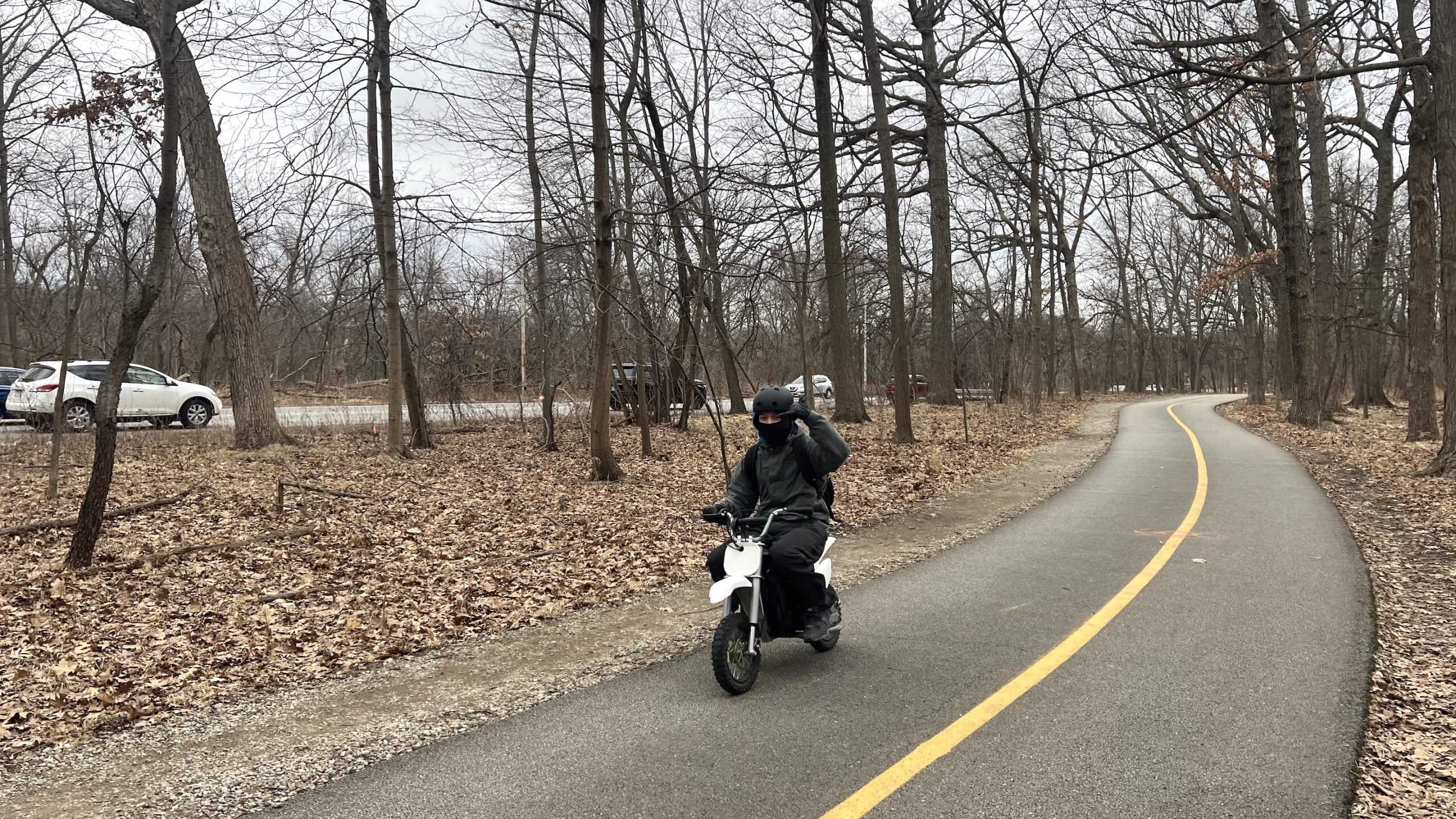
But the legislation addresses e-motos by adding, “Any electric bicycle that is not a low-speed electric bicycle shall be considered a motor driven cycle for purposes of this Code.”
That means a driver’s license, registration, insurance and title would be required to ride them.
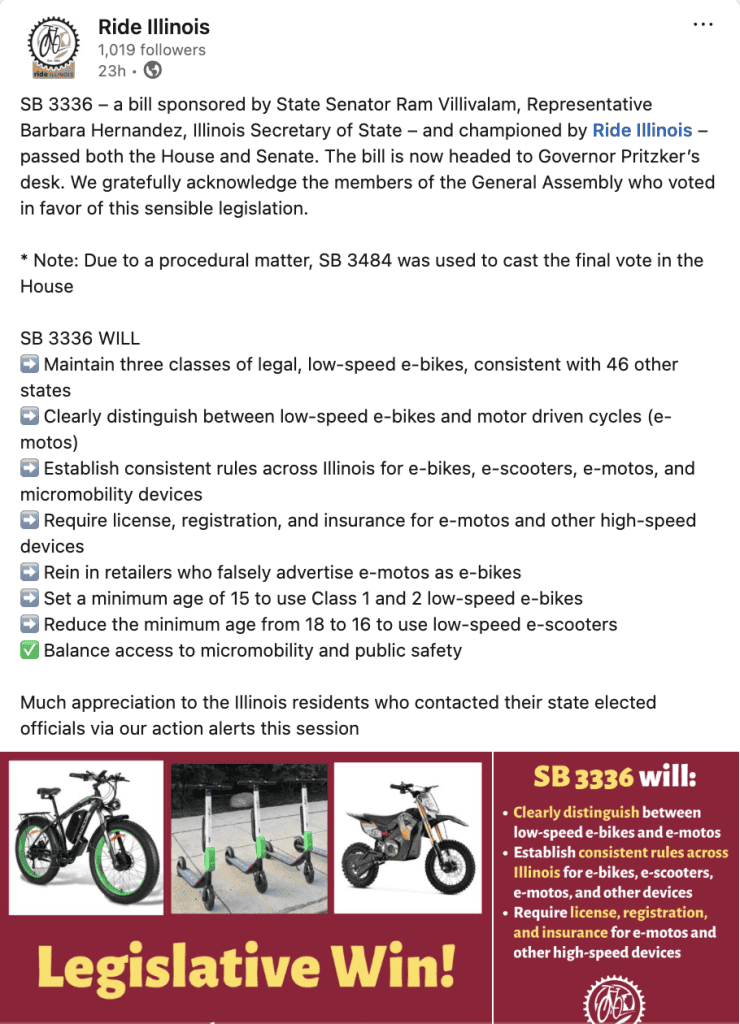
One new broad category that would be added to the state vehicle code is “electric micromobility device.” It includes electric skateboards, electric unicycles, low-speed electric scooters and high-speed electric scooters.
“For purposes of this Code, an electric micromobility device shall be considered a motor vehicle,” the legislation says. But a license, registration, title and insurance wouldn’t be required for them.
Yet riders of such devices would have to be at least 16 years old.
The low-speed e-scooters are now defined as maxing out at 10 mph; the Senate bill would change that to 15 mph. A “high-speed electric scooter” would go more than 15 mph.
But it appears low-speed and high-speed e-scooters would be treated much the same way. And the previous minimum age of 18 for low-speed e-scooters would change to 16.
Then there’s the “low-speed gas bicycle,” which has been legal in the state with a minimum age of 16 and a maximum speed of 20 mph. The legislation would change that maximum to 28 mph, and anything not fitting the low-speed gas bike definition would be considered a “motor driven cycle,” subject to license and registration requirements.
The legislation would define “adaptive electric bicycles,” for people with disabilities, and “toy vehicles” separately, with looser restrictions.
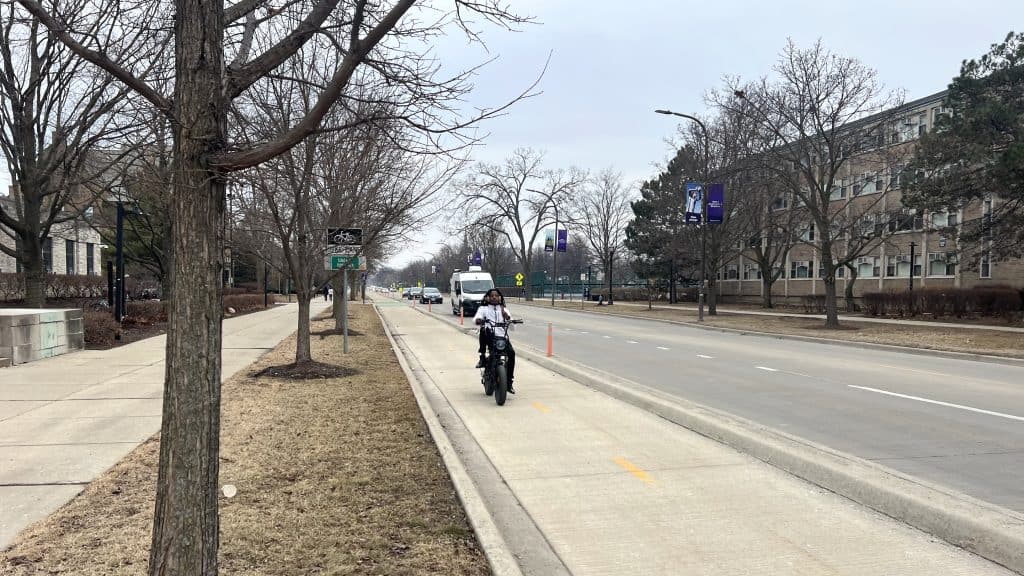
“Motor driven cycles” and “electric micromobility devices” that exceed 28 mph would not be allowed on any bike lanes, bike paths or trails. The legal e-bikes would be allowed on lanes and paths. None of these would be allowed on sidewalks.
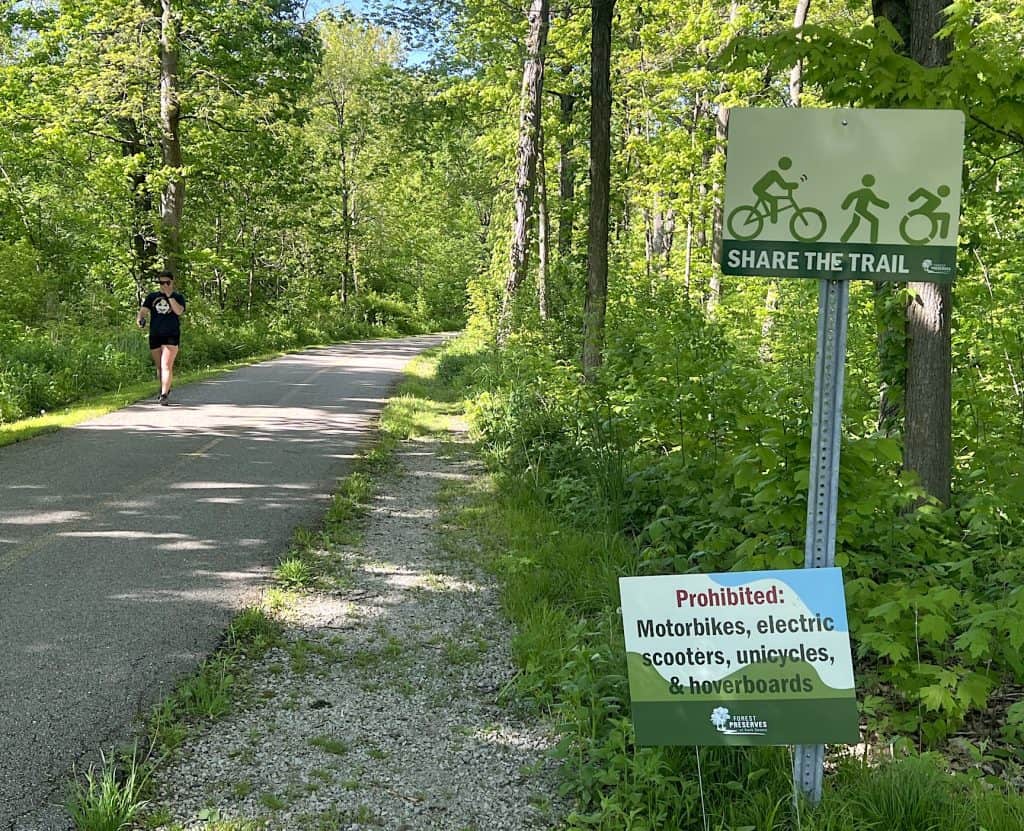
While towns could not change these regulations, local park, forest preserve, conservation and transit districts could add their own rules for their paths.
Overall, signage would be required to indicate where motor driven cycles are not allowed.
Legal e-bikes would still be allowed on streets where bicycles are. “Electric micromobility devices” would be allowed on streets where the speed limit is 35 mph or less, or faster streets only if there’s a bike lane. Gas-powered bikes could be ridden on streets as long as they keep to 28 mph or less. “Motor driven cycles” could be driven on highways, where the state permits.
Key new e-bike regulations
It’s not until near the end of the legislation that a key provision for e-bikes is added: “A person may operate a Class 1 or Class 2 low-speed electric bicycle only if the person is 15 years of age or older.”
That comes on top of the existing minimum age of 16 for Class 3 e-bikes.
Then comes another new, significant provision: “No unit of local government, including a home rule unit, may regulate low-speed electric bicycles.” Local park, forest preserve, conservation and transit districts would be excepted here, too.
Prohibiting towns from regulating e-bikes is big because in 2024 and especially in 2025, many suburbs created their own new local laws. Many applied their own minimum age for e-bike riders, usually 16. Some now also require a driver’s license. Palatine allows 15-year-olds to ride if they have a learner’s permit.
Mount Prospect requires only Class 2 e-bicyclists to be 16, on top of the state’s age 16 requirement for Class 3’s. Two suburbs outright ban all public use of e-bikes. Arlington Heights has a minimum age of 16, but riders can avoid it if they pass two levels of Ride Illinois’ Bike Safety Quiz.
Many towns applied only limited e-bike restrictions or none at all.
The state legislation would not require any driver’s license or permit, and it would set uniform rules on where e-bikes could be ridden — streets, bike lanes and paths, still not sidewalks.
No speed limits were set. And it overrides all municipalities’ laws on minimum age.
Plus the legislation says riders of e-bikes that can hold passengers must be 18 to actually carry passengers unless the passenger is a child or sibling.
The campaign that led to the bill
Preempting local laws contradicts at least somewhat what Secretary of State Alexi Giannoulias said when he launched a campaign to update state law to address e-motos.
Giannoulias said at the time that any new legislation would establish only “baseline standards while preserving local governments’ authority to adopt additional safeguards tailored to their communities.”
But Ride Illinois, the advocacy organization that worked with Giannoulias, had advocated overriding the many varied local laws already created and preventing any new ones. An “action alert” it issued urged people to send a letter to lawmakers telling them to support the legislation in part because it would “nullify the patchwork of municipal ordinances that were passed in 2025 so there is consistency in Illinois communities in regards to micromobility.”
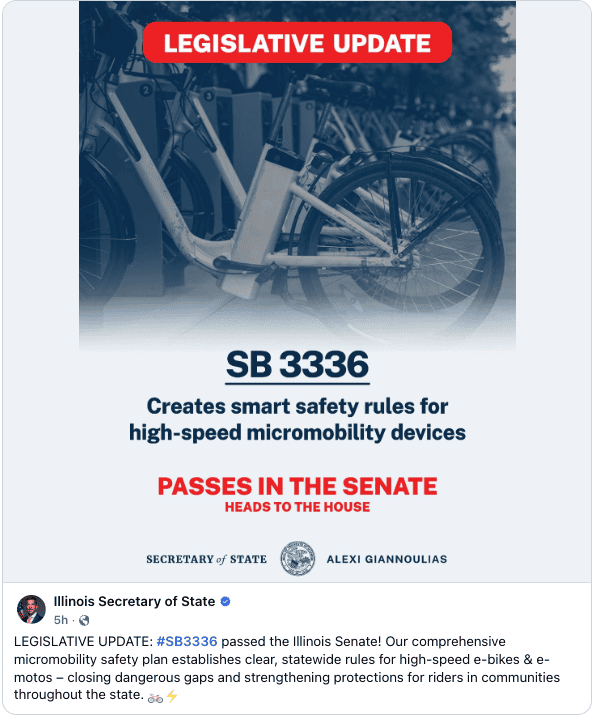
The secretary of state’s office celebrated the Senate bill’s initial April 15 passage on social media.
Ride Illinois has long supported keeping the current state e-bike laws intact to give people of all ages more options for getting around besides cars. In 2025 it began educating local leaders and the public about e-motos and the need to separately regulate them and only them.
(Note: I, the author, volunteer on Ride Illinois’ Fundraising and Membership Committee.)
Meanwhile, the legislation would issue a warning to manufacturers and stores: “No retailer, wholesaler, distributor, or manufacturer shall market, advertise, label, or otherwise offer for sale a motor driven cycle in any manner that would reasonably cause a consumer to believe that the vehicle is a device that is not subject to the requirements of this Section.”
So, for example, something that’s not really a low-speed e-bike could not be called an “e-bike,” as they often are now. Violations would be considered fraud and could bring $10,000 fines.
The House’s original bill
The Senate legislation came after the House starting in February had considered its own legislation that was favored by many suburbs. It would have allowed further local e-bike regulation.
HB4840 dispensed with the different definitions of mobility devices, besides the legal e-bikes, and simply sorted them into “low-speed,” “moderate-speed” and “high-speed” devices. And it stripped any age limits, instead dictating where devices could be ridden.
Under the proposal, “low-speed” devices could have traveled at least 10 and “not in excess of 20 miles per hour using only the motor or throttle.” All low-speed e-bikes would have been included, including the Class 3’s that can go up to 28 mph with pedal power.
“Moderate-speed” devices could have traveled at least 20 and “not in excess of 30 miles per hour using only the motor or throttle.” “High-speed” devices could have exceeded 30 mph with only the motor or throttle.
Arlington Heights itself sorted devices similarly in its 2025 e-bike law.
The legislation would have allowed the low-speed devices on any bicycle path unless a local government prohibited it. Moderate- and high-speed devices would not have been allowed on any bike path or even bike lane.
And riders of moderate- and high-speed devices would not have been allowed to do wheelies.
The House bill was a little clearer about false advertising, saying retailers and manufacturers couldn’t market a high- or moderate-speed device as a low-speed one.
Mayors and other representatives of north and northwest suburbs had filed their support for the House legislation. The Northwest Municipal Conference, of which a lot of those suburbs are a part, listed the bill on its “Key Legislation” page.
But this original House bill died as the Senate bill gained traction.
The support for the Senate bill
Representatives of Ride Illinois and Giannoulias’ office filed in support of the Senate legislation, and the Active Transportation Alliance issued an “action alert” to back the bill, too.
Giannoulias’ effort to update state law also had the backing of the Illinois Association of Chiefs of Police and the Illinois High School and College Driver Education Association; they’re also represented on the Senate bill’s list of support.
Suburban police representatives also backed the bill, as did representatives of the Illinois Municipal League, the Lurie Children’s Hospital of Chicago and other organizations.
Many suburbs enacted their own e-bike laws in the first half of 2025, many rather creative, before a calming campaign slowed the pace of new ordinances. Local leaders began calling on state lawmakers to make new umbrella legislation and said they’d wait on them. Elgin leaders in the spring said they’d wait.
• Do you find up-to-date information valuable? It’s provided with the support of readers like you. Consider donating to help defray the costs of this website and gathering the material for it.