Last updates: Palatine, Hoffman Estates, Arlington Heights, Rolling Meadows, Glenview mentions added Sept. 18. Mention of Rolling Meadows’ ordinance also was added Sept. 10. Orland Park’s ban was added Sept. 3.
Suburbs one by one are enacting laws to regulate e-bike use, and they’ve gotten creative in coming up with them.
The state and counties have their laws on e-bikes, but the state allows local governments to add restrictions. Yet there’s not much guidance on how to do it, and the variety of e-bikes and other, sometimes stronger motorized vehicles (“e-motos” is becoming the lingo for them) has quickly become confounding. Especially when children are seen on all of them.
Some towns are using age restrictions. Some are requiring full driver’s licenses. One requires proof of insurance on the e-bike. Proof of insurance?
Some allow the e-bikes on local paths, some don’t — even if the paths were built for bikes in the first place. Some do allow e-bikes on paths if the riders don’t use the motor. But who’ll watch them? Two towns are not allowing e-bikes on any public property, be that streets or paths.
And speed is a principal concern, often forming the basis of laws. But what speed should be the threshold? Suburbs are showing different ways of tackling it.
Age and licenses
The state dictates an age only for Class 3 e-bikes, which can go up to 28 mph; riders must be 16. But Schaumburg in June expanded that age limit to all e-bikes, down to the Class 1’s that can go up to 20 mph only by pedaling.
Elk Grove Village took it a step further shortly afterward, requiring e-bike riders to have a driver’s license. The rationale, according to Mayor Craig B. Johnson, is that training for the license, even if it’s about autos, makes people aware of the rules and dangers of the road, and e-bike riders should be as mature as auto drivers. And because the problem is mostly with children, Johnson has said, their safety has to come first.
“To operate <e-bikes> on a public roadway with 3,000-pound cars right next to you, you need to have some experience and age behind you,” he said on a segment on WBEZ Chicago.
Highland Park, Fox Lake, Carol Stream and Evergreen Park followed with the age and license requirements, while Roselle and Hanover Park are following only with the 16 age limit. The Park Ridge City Council debated the age restrictions, finally settling on 14 for Class 1 and 2 e-bikes, and 16 for Class 3. Hoffman Estates is allowing only Class 1 and 2 e-bikes, with an age minimum of 16.
Palatine added age requirements but licenses only for a few ages. It’s allowing 15-year-olds to ride e-bikes if they have a learner’s permit. It’s requiring a driver’s license of 16- and 17-year-olds, but after pleas to ease up on older riders, the city council decided driver’s licenses are not required for those 18 and older.
Huntley imposed the age limit last fall. Other towns like Glen Ellyn, Hinsdale and Burr Ridge did not add their own age limits; Arlington Heights and Rolling Meadows later did the same.
Streets, paths and motors
Elk Grove is thinking street safety with its driver’s license requirement, but the village is allowing e-bikes only on village streets, if the riders want to use their motors. It’s not allowing bikes with the electric assistance on local paths.
Others are doing the same. The age-motor link is the core of Roselle’s new law; all e-bike riders must be 16 if they want to use the electric assist. That’s what Huntley started requiring late last fall, in response to police calls involving e-bikes on paths and other public property.
“The top safety concern we have with e-bikes is younger riders operating them in an unsafe manner, and the use of motor-assisted speed is a big part of the problem,” Roselle Police Chief Rob Barreto said in a news release.
Roselle’s at-large law came after the town’s park district set its own rules, where Class 1 e-bicyclists are allowed on designated park trails and paths, and they must be 16. Traditional bicyclists are also allowed on the paths, but Class 2 and 3 e-bicyclists are not.
Highland Park, Carol Stream, Fox Lake, Evergreen Park and Burr Ridge also are allowing e-bikes only on roads. Evergreen Park’s further limits e-bikes to roads with 25 mph speed limits or less, in contrast to the more common 35 mph limit in other towns.
Like Elk Grove leaders, Highland Park leaders say they’re seeing danger in spaces shared with pedestrians.
Orland Park and Glenview have banned e-bikes from all public locations. All of them. “It is illegal to operate E-bikes and E-scooters in the Village of Orland Park,” it said in a Facebook post. “This includes public streets, sidewalks, parking lots, bike paths and public parks.”
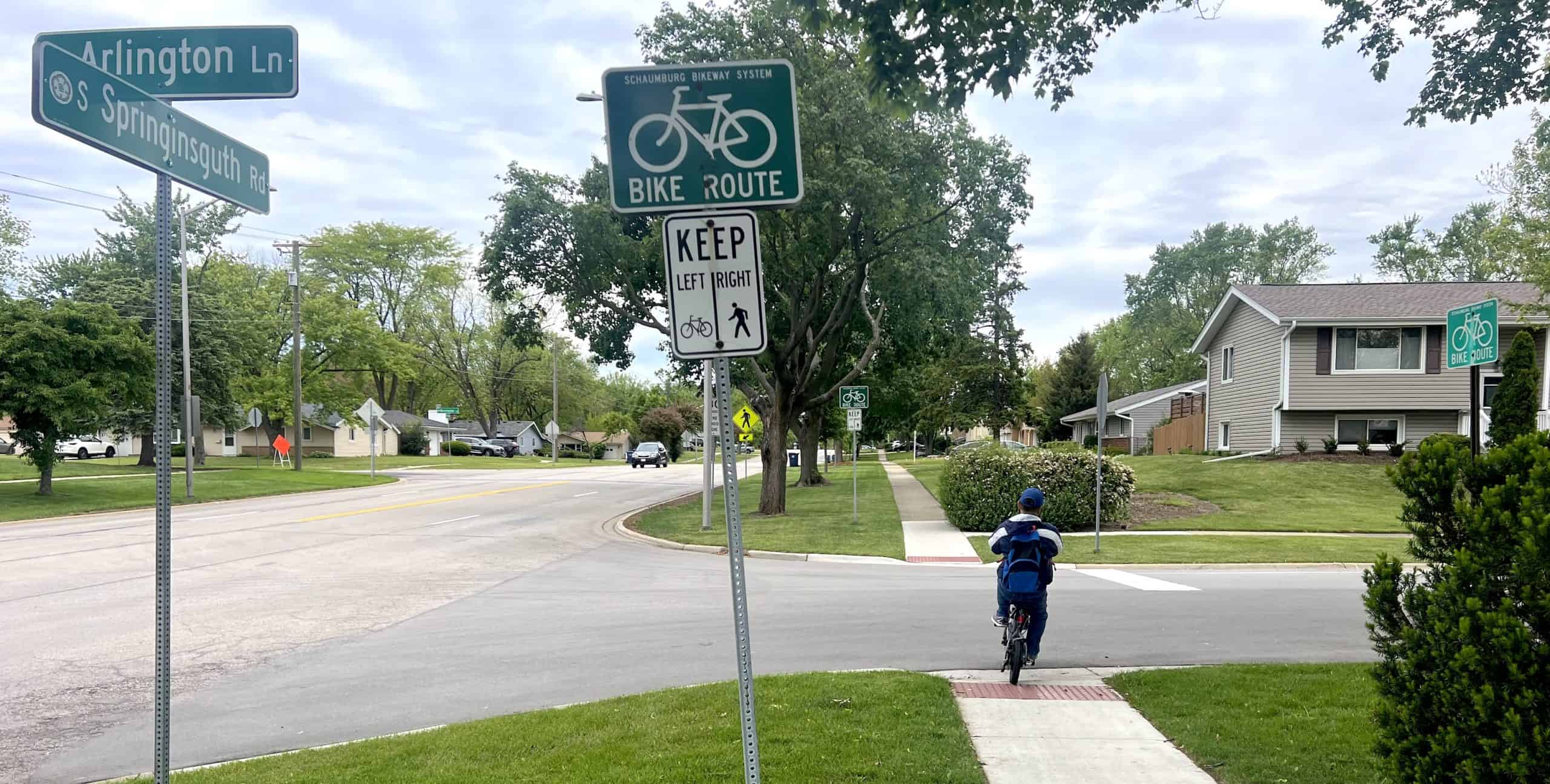
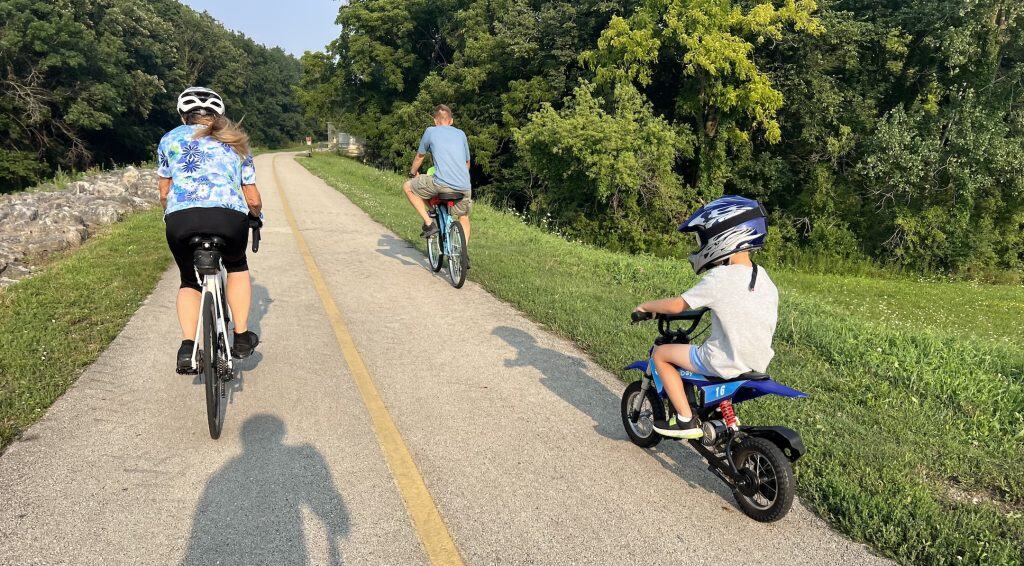
Schaumburg isn’t being so restrictive on location. Its ordinance says all e-bikes, even those running up to 28 mph, can be used on paths and streets, unless signs indicate otherwise. The only problem is that some official bike routes in the village are narrow sidewalks (like in the picture at the top of this article), so e-bicyclists are still riding on them, too.
Other towns like Glen Ellyn and Lake Forest have specified only that e-bikes are not allowed on their downtown sidewalks; Arlington Heights in September did something similar. Glen Ellyn also dictates where e-bikes can be parked.
10 mph rule and proof of insurance?
Fox Lake based its new law entirely on a 10 mph threshold. Where did that come from? That’s the maximum speed that the state allows for e-scooters; it’s not a factor with e-bikes.
So when the village prohibits e-bikes and e-scooters “capable of exceeding 10 mph from sidewalks or pathways,” welp, that’s about all e-bikes unless a small toy one actually stays slower than 10 mph. Even “low-speed” e-bikes are recognized in the state for maxing out at 20 mph or more.
That’s not the only creative difference in Fox Lake’s law. It also is requiring that the e-bikes be insured and that the rider carry proof of said insurance.
Who has e-bike insurance? Well, plenty of insurance carriers offer it. How many e-bike owners, or kids’ parents, have thought of it is another matter.
Helmets and lights
Helmets are not required on e-bicyclists or any bicyclists under state law, but some towns now are requiring them for e-bike riders. Schaumburg, Highland Park and Palatine are among them.
Helmets are about all Deerfield is requiring of e-bicyclists beyond state law, and even then, it’s making only riders 15 and under wear them. Other suburbs with otherwise strong laws, like Elk Grove and Fox Lake, don’t mention helmets.
Meanwhile, many suburbs say lights are required at night, but that’s state law anyway. Lights are not required on bikes in Illinois during the day.
The parents
Suburbs are varying on holding parents accountable for their children’s use of e-bikes.
Schaumburg has said only that “parents/caregivers are responsible for ensuring their children understand traffic safety and are following both state and local laws.” Highland Park says “parents or guardians may be held responsible for minors” and actually requires them to accompany e-bike riders who don’t have a driver’s license. At least a few other suburbs follow that practice.
Hanover Park says “it shall be unlawful” for a parent to allow a child to violate its local law. Roselle says both parents and children can get tickets for violating local law, and the e-bike impounded. Many other suburbs have since followed suit.
Elk Grove Village’s ordinance says any violators under 18 must be picked up by a parent or guardian after police stop them, or violators will be held at the police station until they’re picked up.
Enforcement
Meanwhile, enforcement philosophy is varying. Often in the discussion of a new e-bike law, the question of “how will it be enforced” comes up and becomes a sticking point.
Schaumburg Mayor Tom Dailly told the Daily Herald the new regulations are an opportunity for greater education because “no matter what we do, enforcement is going to be difficult.” But the suburbs, like many others, have set up tiered fines based on the number of offenses.
Fines go up to $500 in Schaumburg and Huntley, or even $1,000 in Evergreen Park. They start as low as $25 in towns like Huntley, but Highland Park was considering a minimum of $100. Park Ridge is limiting fines to $50.
Huntley also was pledging to deemphasize enforcement. Village President Tim Hoeft said that if people aren’t giving police a reason to pull them over, they won’t be checking if e-bike riders are using their motors on public paths or property, Shaw Local reported.
Hinsdale implemented no new e-bike laws, reiterating only state law, but it has stepped up enforcement. The suburb aims to ensure only the low-speed e-bikes (within the state’s three classes, in which e-bikes still could go 20-28 mph) are being used, with fines up to $750. ABC 7 Chicago reported that the village had issued 150 citations as of late June.
Even faster vehicles and buying advice
Also addressing the motor size issue, Streamwood updated its e-bike law only to reiterate its enforcement of state law against motorbikes known as “mini-motorcycles” and “pocket bikes” on local streets. Hinsdale, meanwhile, also has made motor size the center of a publicity campaign.
“In order to be considered a legal low-speed electric bicycle, it must be equipped with pedals and an electric motor with a power output of less than 750w, as cited by Illinois State Law,” the village said in a notice. “Only bicycles or legal low-speed electric bicycles, and adults on low-speed scooters can share the roadway with motorists in Hinsdale.”
The village even warns about purchasing decisions. “Be aware of deceptive advertisements from manufacturers that promote their products as ‘electric bicycles.’ If a product is equipped with a motor output of 750w and greater and has two wheels, it is no longer considered a bicycle.”
It produced a flyer illustrating both legal and prohibited motorized bikes, as other towns have done on web pages or social media posts.
So where to ride with what?
The varying new laws so far are creating inconsistency and problems for people, including parents, who already did buy from a market of motorized bikes that quickly became saturated. The “genie is out of the bottle,” Dave Simmons, executive director of Ride Illinois, told Ralph Banasiak in the Daily Herald. The market responded to growing interest in inexpensive, sustainable transportation powered by electric motors.
Manufacturers weren’t necessarily specifying which bikes were legal e-bikes in Illinois, to say nothing of which e-bikes would be legal for children in a given town.
Well-meaning young e-bike riders are caught in a bind. What if a child, at last being healthier and environmental by using a bike to go to school rather than the bus or a ride from their parents, can no longer legally ride in their town? The child may now be too young to use an e-bike. Or maybe they can’t get to school because they’re not allowed to use even a multi-use path on the way.
“I wish they didn’t ban them. There are so many kids around the area that have the same bikes as me,” a 14-year-old wrote to Suburban Chicago Bicycling. He has a Talaria e-bike that really isn’t a legal e-bike in Illinois but basically a mini-motorcycle. “And it’s all we do. Just ride every day.” He doesn’t like to ride on streets because “there are some crazy drivers out there.”

The lack of infrastructure could be a problem for e-bike riders of any age. Must an adult running errands ride only on streets, not on a local path, even if the streets aren’t so comfortable because of traffic? Are seniors who try to get out and keep healthy on e-bikes relegated to streets or county trails — if they have a way to actually get to those trails? What about people who just can’t drive for whatever reason?
One commenter, Rusty Shackleford, on a Daily Herald story about Hanover Park’s ordinance made a point about lacking infrastructure.
“It’s notable that most of these regulations are only really happening in what I call the ‘Schaumburg Belt,'” he wrote. “It’s an area of the outer suburbs that didn’t get developed until the ’60s, meaning they were built to be heavily car dependent, and thus not at all walkable or bikeable. Places with a built environment more conducive to biking seem to be more open to e-bikes, since there are actually facilities to handle them.”
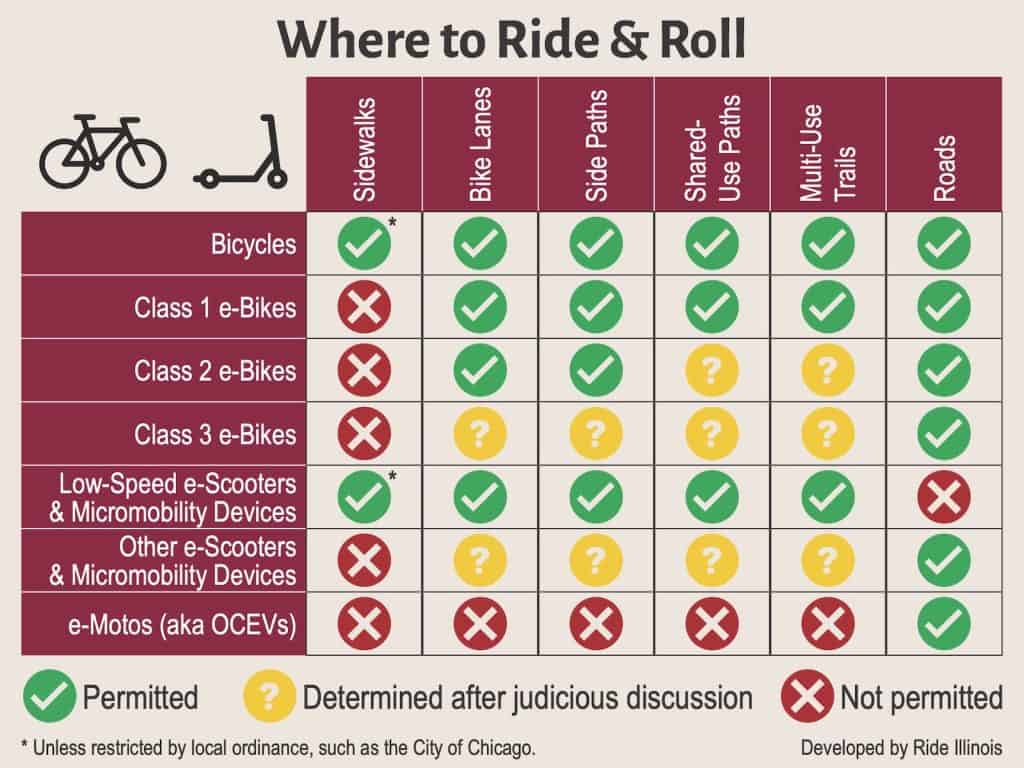
Simmons wants suburbs to distinguish between the three classes of e-bikes, already guided by state law, and other motorized bikes, like the mini-motos or “e-motos” as they’re starting to be called, that he says do need further regulation particularly because of their even higher speeds and use by children. Ride Illinois has made a chart suggesting which kind of vehicles should go where.
Driver’s license and road debate
Elk Grove’s Mayor Johnson didn’t distinguish among motorized vehicles when asked about his village’s new law in the WBEZ segment in which Simmons also was interviewed.
“Whether you have a car, motorcycle or e-bike, they’re motorized modes of transportation, and they have a different responsibility and different characteristics than just riding a normal bicycle or a normal scooter,” Johnson said.
He noted that e-bikes on the roads going only 28 mph or less force auto drivers to go around them. But Simmons noted that bicyclists also go slower than auto drivers, plus are not necessarily licensed.
“At what point do we slide into saying bicycles are not allowed on the roads?” he asked on WBEZ. “Bicycles are legal vehicles in the state of Illinois. … Someone on a bicycle can go 15, someone on a bicycle can go 20. The focus should be on safely integrating these new modes.”
Simmons is leading Ride Illinois’ campaign to distinguish e-bikes from “e-motos,” bikes with motors of more than 750 watts, and to add e-motos to the state vehicle code as motorized vehicles. His campaign persuaded the Rolling Meadows city council to follow state law on e-bikes, allowing broad use. Others like Arlington Heights and Mount Prospect are following suit.
There’s agreement that infrastructure is a lot of the problem.
“We have seen that asking people nicely to follow the rules doesn’t always work,” Jim Merrell, advocacy director of the Active Transportation Alliance, said on the WBEZ segment. “We’re big proponents of infrastructure being the way to really shape behavior. We can redesign roadways to get people to slow down, we can create safer spaces for people to ride e-bikes.”
“We don’t want to throw the baby out with the bathwater when it comes to having this great new accessibility tool which opens biking and is a sustainable way to get around.”
And Johnson said he’d really rather not have differing local laws.
“We shouldn’t have to be doing this. Because they’re technically motorized vehicles or motorized modes of transportation, the state should step in. Just like they do for cars, whether it’s gas or electric-powered cars, just like they do for motorcycles … they should set a uniform code.”
• Local e-bike laws, town by town: See the round-up.
• Do you find this news and analysis valuable? Consider donating to help defray the costs of suburbanchicagobicycling.com.