First published June 11, 2026.
Illinois lawmakers on June 1 passed legislation adding a key new regulation for e-bikes while also regulating, for the first time in most cases, the two-wheeled and other motorized vehicles that fall between e-bikes and motorcycles. Gov. JB Pritzker on Aug. 26 signed the legislation into law, to take effect Jan. 1.
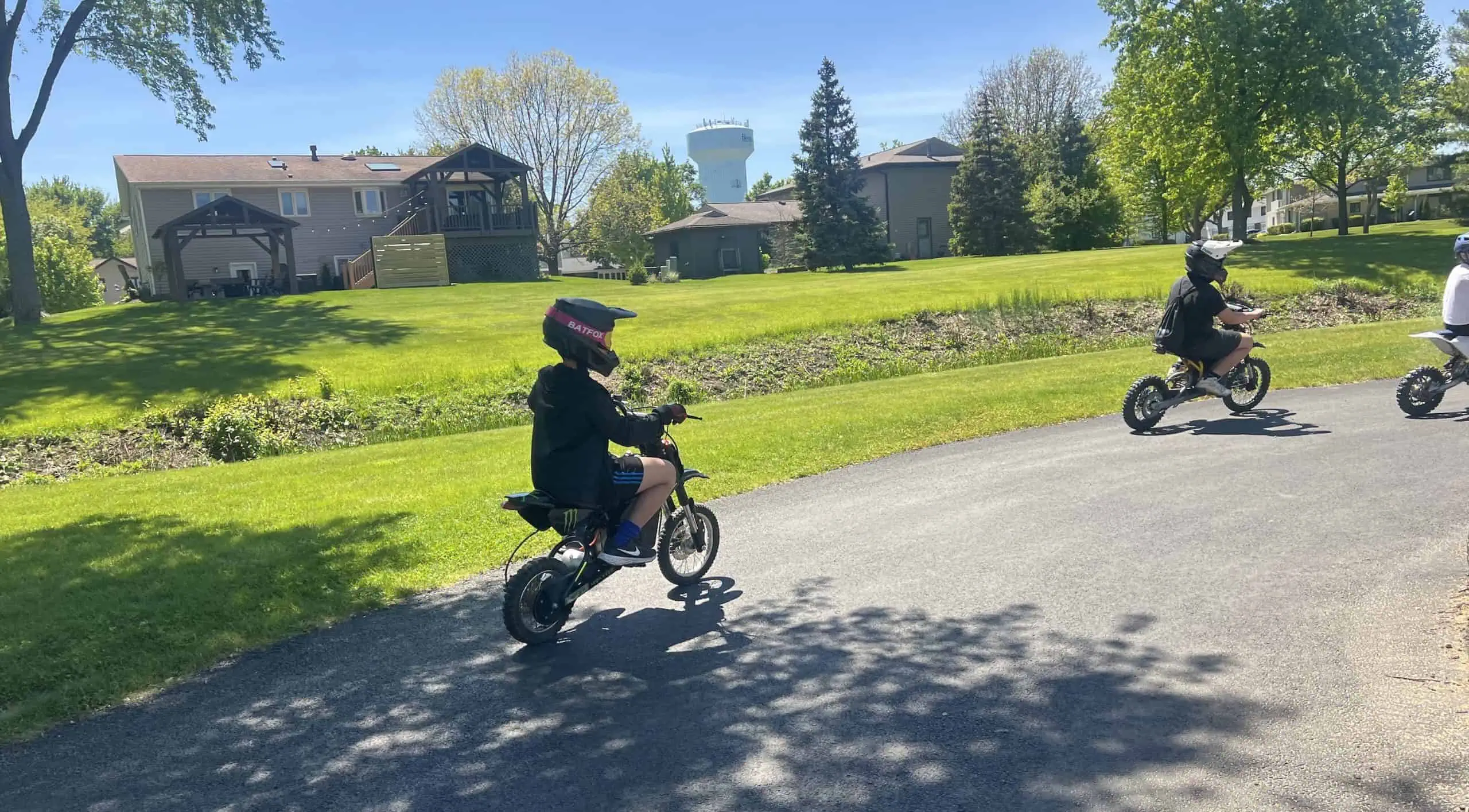
The more powerful two-wheeled bikes short of motorcycles have been casually called “e-motos.” Starting in 2027, they’ll officially be called “motor driven cycles” in Illinois, just like motorcycles. That comes with big implications.
Then there are “electric micromobility devices.” Those include electric skateboards, electric unicycles and electric scooters. They’ll be more thoroughly regulated, too.
The legislation creates regulations for the whole state that override all the varying local laws written starting in 2024 and especially in 2025. Advocacy group Ride Illinois helped create the law with the secretary of state’s office.
Does it simplify the situation?
Let’s break it down as quickly as we can.
E-bikes
What’s new starting in 2027: Riders of Class 1 and 2 e-bikes must be 15 years old. That’s on top of existing law that says Class 3 e-bike riders must be 16.
The three classes of e-bikes, officially called “low-speed electric bicycles,” will remain:
- Class 1: Bikes with a motor that provides assistance only when the rider is pedaling, maxing out at 20 mph.
- Class 2: Bikes with a motor that can propel the bicycle without the rider necessarily pedaling, maxing out at 20 mph.
- Class 3: Bikes with a motor that provides assistance only when the rider is pedaling, maxing out at 28 miles per hour.
These all have a motor with power of less than 750 watts.
Where they could be ridden: Bike paths and trails, bike lanes, any streets where bicycles are allowed. Not sidewalks. Never sidewalks.
Also: The legislation says riders of e-bikes that can hold passengers must be 18 to actually carry passengers unless the passenger is a child or sibling.
Faster e-bikes
What’s new starting in 2027: “Any electric bicycle that is not a low-speed electric bicycle <as defined above> shall be considered a motor driven cycle for purposes of this Code,” the legislation says. That would be any bike with a motor of 750 watts or more.
And that means a driver’s license, registration, insurance and title would be required to ride them.
That presumes the minimum age of 16 required for a driver’s license.
Where they could be ridden: Streets and even highways, where the state permits. They could not be ridden on bike paths or trails, or bike lanes. And not sidewalks. Never sidewalks.
E-scooters, e-unicycles, e-skateboards
What’s new starting in 2027: The “electric micromobility device” category will be added to the state vehicle code. It includes electric skateboards, electric unicycles, low-speed electric scooters and high-speed electric scooters.
“For purposes of this Code, an electric micromobility device shall be considered a motor vehicle,” the legislation says.
That means drivers of such devices must be 16 years old.
But such devices are excepted from the license, registration, insurance and title requirements.
E-scooter changes:
- “Low-speed” e-scooters’ maximum speed changes to 15 mph from 10 mph.
- “High-speed electric scooter” is a new definition for a scooter that goes more than 15 mph.
- The minimum age for a low-speed e-scooter changes to 16 instead of 18.
- And the minimum age for a high-speed e-scooter also will be 16.
- In the end, all e-scooters are treated the same.
Where electric mobility devices could be ridden: As long as they don’t exceed 28 mph, bike paths and trails, bike lanes, and any streets with a speed limit of 35 mph or less, plus streets with speed limits exceeding 35 mph if they have a bike lane. And not sidewalks. Never sidewalks.
Gas-powered bikes
What’s new starting in 2027: A “low-speed gas bicycle” has been in the state vehicle code, but the maximum speed will change to 28 mph from 20 mph. The minimum age of 16 remains.
Any gas bicycle that can exceed 28 mph becomes a motor driven cycle, subject to the same license, registration, insurance and title requirements that high-speed e-bikes will have, and the same location limits.
Where they could be ridden: On any street and highway where the state permits. As long as they don’t exceed 28 mph, any bike path or trail, or bike lane where bicycles are allowed. And not sidewalks. Never sidewalks.
Also: Like with low-speed e-bikes, the legislation says riders of gas bikes that can hold passengers must be 18 to actually carry passengers unless the passenger is a child or sibling.
The park district provision
Late in the writing of the legislation, a provision was added to allow park, forest preserve and conservation districts to regulate the use of motorized devices only on their trails and paths.
So some paths where e-bikes and other devices are allowed by the state could be off-limits if a local park or forest preserve district says so.
Toy vehicles
What’s new starting in 2027: “Toy vehicle” will be a new part of the vehicle code for devices designed for kids age 7 or less and not exceeding 10 mph.
Where they could be ridden: Sidewalks! And paths. That’s it.
But note: Any municipality, park or forest district could restrict their use on their property, but not anywhere else in a town.
Adaptive e-bikes
What’s new starting in 2027: Also late in the legislative process, the separate “adaptive electric bicycle” category was created. It refers to an e-bike “designed for and used by a person with a mobility disability.”
They will treated like non-motorized bicycles, allowed anywhere regular bikes can go.
No speed limits
The legislation sets no speed limits for e-bikes or other devices in certain places, other than generally 28 mph on paths.
That means suburbs that have set speed limits, such as 15 mph on paths, would be overruled.
The exception, again, is park and forest preserve paths and trails. The districts overseeing those could set their own limits — and 15 mph is a common limit on county trails.
Enforcement
Enforcement of any laws on e-bikes and other devices has always been a big question even as local laws were made. Many suburbs said they would focus more on education and awareness than punishment, though many also issued tickets with fines that could be big or small.
For its part, the new state legislation specifies that local police could confiscate and impound vehicles if misused, and impose a fee for their return, only in the “motor driven cycles” and “electric micromobility devices” categories. That applies to high-speed e-bikes and gas bikes, and e-scooters, e-unicycles and e-skateboards.
The legislation doesn’t specify such enforcement for low-speed e-bikes, now with the new minimum age requirement — even though many suburban laws now say they can be confiscated and impounded. But it’s presumed that police will be able to enforce the e-bike age rules as they would any state vehicle law.
Quicker summary
The office of Secretary of State Alexi Giannoulias has published a handy cheat sheet outlining the most common scenarios. Here it is:
• Do you find information like this valuable? This free website is made possible almost entirely by readers like you. Consider donating to help defray the costs of gathering and presenting this material.
These statements in the article are incorrect: “These all have a motor with power of less than 750 watts” and “That would be any bike with a motor of 750 watts or more.”
It is not less than 750W. It is up to and including 750W. It would have to be MORE than 750W to be in a different class (other than class 1, 2 or 3).
Thank you for the sharp eye, Jake. What you say is not how the law is reading, or how it read before (as I’ve been corrected on it when I had it in articles the way you say). Here’s the law excerpt:
“Sec. 1-140.10. Low-speed electric bicycle. A bicycle equipped with fully operable pedals and an electric motor of less than 750 watts that meets the requirements of one of the following classes:”
https://ilga.gov/Legislation/BillStatus/FullText?GAID=18&DocNum=3484&DocTypeID=SB&LegId=166485&SessionID=114#:~:text=21-,Sec,-.%201%2D140.10.
BUT, to your point, the law also says this:
“Motor driven cycle. Every motorcycle, moped, and every motor scooter with an internal combustion engine of less than 150 cubic centimeter piston displacement, or an electric motor with a nominal power rating of greater than 750 watts but less than or equal to 8,000 watts, including motorized pedalcycles and every electric bicycle or gas-powered bicycle that is not a low-speed electric bicycle.”
So something that has exactly a 750-watt motor … doesn’t have a category! Though it says that “every” electric bicycle that is *not* a low-speed electric bicycle (defined as having a motor of *less than* 750 watts) is also a motor driven cycle.
While it will be the responsibility of each local police department to monitor and enforce the new laws on e-bikes in 2027, are any of the police departments actually prepared? Are they going to claim being understaffed and raise taxes to enforce the new laws?
Is consensus reactive vs. proactive?
I was on the McClorry last Thursday and almost run over by a kid on an e-bike doing 30 mph.
There certainly is a large percentage of ebikers obeying laws and wearing helmets. It’s that small percentage that take advantage, be reckless and do what they want.
It’s going to be interesting that’s for sure.